VENTS vs PIONEER: Ventilation Fans Compared by Specs
Compare VENTS and PIONEER ventilation fans by published specs. Review airflow capacity, dimensions, and smart features to find the right ERV for your space.
7 min read

Reviewed
VENTS vs PIONEER: Ventilation Fans Compared by Specs
Price today
| Amazon | Not listed | View deal |
|---|
We track one retailer, so this is not a price comparison. Affiliate link; price and stock come from the listing and change without notice.
As Amazon Associates, we earn from qualifying purchases. This means we may receive a small commission at no extra cost to you if you click through and make a purchase.
As an Amazon Associate we earn from qualifying purchases. Links on this page are affiliate links.
You are comparing the VENTS vs PIONEER ventilation fan options for single-room air exchange. Both units are ductless energy recovery ventilators designed to improve indoor air quality while conserving energy. They recover heat or cooling from exhaust air to condition incoming fresh air. The main difference lies in their airflow capacity, filtration standards, and smart features. Pioneer offers higher airflow and advanced connectivity, while VENTS focuses on ultra-quiet operation and humidity sensing.
Max Airflow
30 CFM
35.3 CFM
Filtration
MERV 5
F7 (MERV 13)
Smart Control
Wireless remote
Wi-Fi app and remote
Sensors
Humidity sensor
CO2 sensor
Power Consumption
4.5 watts
8 watts
Choose the first if
- You prioritize the quietest possible operation for a bedroom or nursery
- You need automatic humidity control to manage moisture levels
- You want the lowest possible power draw for energy efficiency
Choose the second if
- You require higher airflow to ventilate larger rooms up to 500 sq ft
- You want advanced filtration to capture smaller particles like allergens
- You prefer controlling the unit via a smartphone app from anywhere
Verdict
Choose the VENTS model if your top priority is silent performance and humidity management in smaller spaces. Select the Pioneer unit if you need stronger airflow, superior filtration for allergens, and the convenience of Wi-Fi control. Both units effectively exchange air while recovering energy.
Ventilation Specs and Features Compared
Airflow capacity
Edge: Pioneer 50 ERV White Wall-Mount
The Pioneer 50 ERV moves up to 35.3 CFM on its highest setting, while the VENTS TwinFresh Comfo provides 30 CFM. This difference matters if you need to exchange air in a larger space quickly. The Pioneer handles up to 35 CFM, giving it a slight edge in raw volume. The VENTS unit caps at 30 CFM, which is sufficient for rooms up to 500 square feet. If your room exceeds that size, the Pioneer’s higher output may maintain fresher air faster. Both units offer continuous operation, but the Pioneer allows variable speeds up to max, whereas the VENTS focuses on steady, efficient exchange. Choose the Pioneer for higher airflow needs.
Filtration grade
Edge: Pioneer 50 ERV White Wall-Mount
Filtration quality directly impacts the air you breathe. The Pioneer 50 ERV uses a washable prefilter and an F7 (MERV 13) filter. This higher grade captures smaller particles like dust, pollen, and microbial volatile organic compounds (MVOCs). The VENTS TwinFresh Comfo uses a MERV 5 filter. MERV 5 traps larger particles but lets smaller irritants pass through more easily. For allergy sufferers or those sensitive to fine dust, the Pioneer’s MERV 13 filter is significantly more effective. The VENTS unit is better suited for basic dust reduction. If clean air is your priority, the Pioneer’s superior filtration is the clear advantage.
Smart control
Edge: Pioneer 50 ERV White Wall-Mount
Control methods vary between these two units. The Pioneer 50 ERV includes Wi-Fi connectivity, allowing you to manage the fan via a free smartphone app. It also comes with a standard handheld remote and onboard interface. The VENTS TwinFresh Comfo relies on a wireless remote control and does not mention Wi-Fi or app integration. If you prefer adjusting settings from your phone or automating ventilation based on your schedule, the Pioneer offers modern convenience. The VENTS unit is simpler, relying on physical remote commands. For tech-enabled control, the Pioneer is the better choice.
Sensors and monitoring
Edge: Tie
Automation features differ in their approach to air quality. The Pioneer 50 ERV includes a built-in CO2 sensor that monitors oxygen and carbon dioxide levels, automatically adjusting ventilation to maximize breathability. The VENTS TwinFresh Comfo features a humidity sensor that responds to excess moisture to prevent condensation and mold. Neither unit lists both sensor types. If you need to manage humidity levels in a basement or bathroom area, the VENTS sensor is useful. If you want to maintain optimal CO2 levels for cognitive function and comfort, the Pioneer’s sensor is more beneficial. Your choice depends on whether humidity or CO2 is your primary concern.
Energy efficiency
Edge: VENTS TwinFresh Comfo 30 CFM ERV
Both units are designed for low power consumption. The Pioneer 50 ERV uses an average of 8 watts, with specific draws of 6, 7, and 8 watts across its speed settings. The VENTS TwinFresh Comfo uses as little as 4.5 watts and operates with a high-efficiency reversible DC motor. The VENTS unit is slightly more energy-efficient at its lowest setting, drawing less than half the power of the Pioneer’s lowest speed. However, the Pioneer maintains high efficiency with up to 97% heat recovery, compared to the VENTS’ 88%. For pure wattage savings, the VENTS wins. For heat recovery performance, the Pioneer is superior.
Noise level
Edge: VENTS TwinFresh Comfo 30 CFM ERV
Quiet operation is critical for bedrooms and offices. The VENTS TwinFresh Combo operates as quietly as 0.2 sones, which is barely audible. The Pioneer 50 ERV has a maximum sound output of 32.7 dB(A). Converting decibels to sones is complex, but 32.7 dB is generally considered very quiet, though the VENTS explicitly advertises a 0.2 sone rating. The VENTS unit emphasizes its ultra-quiet performance for nurseries and guest rooms. If absolute silence is your top priority, the VENTS specification is more reassuring. The Pioneer is still quiet, but the VENTS takes the edge for low-noise claims.
Which ventilation fan fits your needs
You want smart home integration
Our pick: Pioneer 50 ERV White Wall-Mount
The Pioneer model includes Wi-Fi connectivity and a free smartphone app. This allows you to monitor and control the unit remotely. You can adjust settings or check status from your phone. The VENTS option relies on a basic wireless remote. If you prefer managing your ventilation through a dedicated app interface, the Pioneer’s connectivity features offer greater convenience and flexibility for your daily routine.
You prioritize ultra-quiet bedroom use
Our pick: VENTS TwinFresh Comfo 30 CFM ERV
The VENTS TwinFresh Comfo operates as quietly as 0.2 sones. This sound level is exceptionally low and barely audible during normal use. The Pioneer model has a maximum sound output of 32.7 dB(A). While quiet, the VENTS unit offers superior silence for sensitive environments. If you need a ventilation solution for a bedroom, nursery, or office where noise is a primary concern, the VENTS specifications provide the quieter performance you require.
You need advanced air quality sensors
Our pick: Pioneer 50 ERV White Wall-Mount
The Pioneer unit features a built-in CO2 sensor for automated air quality management. It monitors oxygen and CO2 levels to maximize breathability inside the room. The VENTS model includes a humidity sensor but lacks CO2 monitoring. If you want the system to automatically respond to carbon dioxide buildup, the Pioneer’s sensor technology provides more comprehensive indoor air quality control without manual intervention.

VENTS TwinFresh Comfo 30 CFM ERV
Best for: Quiet, ductless single-room ventilation
- Airflow Rate
- 30 CFM
- Ventilation Type
- ERV
- Mounting Type
- Through-the-wall
- Filter Type
- MERV 5
- Control Method
- Wireless Remote Control
- Motor Type
- Reversible DC
The VENTS TwinFresh Comfo is a ductless energy recovery ventilator designed for single rooms up to 500 sq ft. It delivers 30 CFM of fresh air while recovering up to 88% of heat or cooling. The unit operates quietly at 0.2 sones and uses only 4.5 watts. It includes a built-in humidity sensor and MERV 5 filters. This model suits spaces where traditional ductwork is not feasible.
- Recovers up to 88% of heat or cooling energy
- Operates at a low sound level of 0.2 sones
- Consumes as little as 4.5 watts of power
- Rated for outside temperatures down to -4°F
- Provides only 30 CFM of airflow
- Uses a basic MERV 5 filter rating
- Limited to single-room application
- You need fresh air exchange in a room up to 500 sq ft
- You require a ductless solution for walls 6–20 inches thick
- You want a unit that operates quietly at 0.2 sones
- You need Wi-Fi connectivity for remote app control
- You require airflow greater than 30 CFM
- You want a higher filtration standard than MERV 5
Verdict: VENTS TwinFresh Comfo 30 CFM ERV is a quiet, energy-efficient choice for single rooms where ductwork is not an option. It fits buyers who prioritize low noise and heat recovery over smart connectivity.
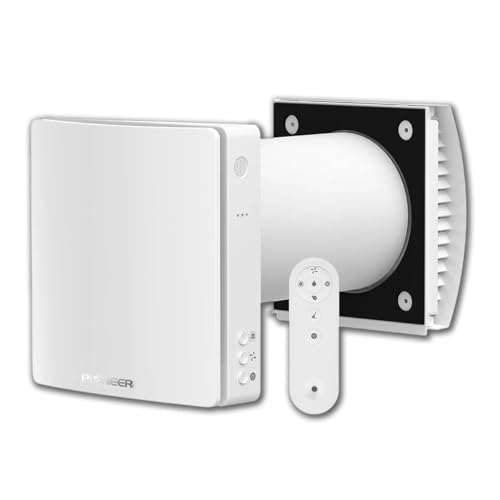
Pioneer 50 ERV White Wall-Mount
Best for: single-room ventilation with smart controls
- Airflow Rate
- Up to 35 CFM
- Ventilation Type
- ERV
- Mounting Type
- Wall-Mounted
- Filter Type
- F7 (MERV 13)
- Features
- WiFi
- Color
- White
The Pioneer 50 is a wall-mounted energy recovery ventilator designed for single-room ventilation. It delivers up to 35.3 CFM of treated airflow and features an F7 (MERV13) filter to remove pollutants. With a built-in CO2 sensor and Wi-Fi control, it manages air quality automatically. This unit suits users seeking efficient heat recovery with minimal energy consumption, drawing only 8W at maximum speed.
- Up to 35.3 CFM airflow with F7 (MERV13) filtration
- Built-in CO2 sensor for automated air quality management
- Wi-Fi control via smartphone app and onboard interface
- Low power consumption of 8W at high speed
- Super-silent operation at 32.7 dB(A)
- Lower maximum airflow of 35.3 CFM compared to the VENTS-US TwinFresh at 30 CFM
- Heavier build at 11 lbs compared to lighter alternatives
- Larger dimensions of 9-3/8 x 19-5/8 x 10-1/8 inches require more wall space
- You need Wi-Fi control for remote monitoring
- You want a wall-mounted unit with high heat recovery efficiency
- You require automated CO2 management for better breathability
- You need a ductless system with higher airflow than 35 CFM
- You prefer a compact unit with minimal wall footprint
- You do not want to manage a smartphone app for controls
Verdict: Pioneer 50 Series Wall-Mount ERV fits users who prioritize automated air quality management and Wi-Fi connectivity in a single-room setup. It is ideal for those seeking efficient heat recovery with low energy use.
Specifications side by side
| Spec | VENTS TwinFresh Comfo 30 CFM ERV | Pioneer 50 ERV White Wall-Mount |
|---|---|---|
| Airflow Rate | 30 CFM | Up to 35 CFM |
| Ventilation Type | ERV | ERV |
| Mounting Type | Through-the-wall | Wall-Mounted |
| Filter Type | MERV 5 | F7 (MERV 13) |
| Control Method | Wireless Remote Control | – |
| Motor Type | Reversible DC | – |
| Features | – | WiFi |
| Color | White | White |
| Connectivity | – | Wi-Fi |
| Dimensions | 18.5 × 9.5 × 10.3 inches | 21.5 × 11.3 × 12.5 inches |
| Weight | – | 11 pounds |
| Size | 30 CFM | 9-3/8" x 19-5/8" x 10-1/8" |
| Model | TwinFresh Comfo RB1-50-2 ERV | ERV-50 |
Frequently asked questions
Which ventilation fan is smaller and easier to fit in tight spaces?
The VENTS TwinFresh Comfo is more compact. Its dimensions are 9.5 inches wide, 10.3 inches high, and 18.5 inches long. The Pioneer 50 ERV is larger at 11.3 inches wide, 12.5 inches high, and 21.5 inches long. If you have limited wall space, the VENTS unit fits more easily.
Do I need Wi-Fi for these ventilation fans to work?
No, Wi-Fi is not required for basic operation. However, the Pioneer 50 ERV includes built-in Wi-Fi for remote control via a smartphone app. The VENTS TwinFresh Comfo does not list smart connectivity features. You can use the Pioneer for automated monitoring or the VENTS for simple, local control.
What is the difference in airflow between these two units?
The Pioneer 50 ERV offers higher airflow capacity. It moves up to 35.3 CFM on its highest setting. The VENTS TwinFresh Comfo provides 30 CFM. If you need faster air exchange in a larger room, the Pioneer moves more air. The VENTS is sufficient for smaller, single-room ventilation needs.
Are these fans available in colors other than white?
Both listed models are available in white. The VENTS TwinFresh Comfo is specified as white. The Pioneer 50 ERV Wall-Mount is also white. If you need a different color to match your decor, these specific models do not offer other options based on the current data.
How do these fans handle heat recovery?
Both units are energy recovery ventilators that conserve energy. They recover heat or cooling from exhaust air to condition incoming fresh air. This process improves indoor air quality while reducing the energy load on your HVAC system. Both the Pioneer and VENTS models use this efficient heat exchange technology.
Which fan is better for users who want remote control?
The Pioneer 50 ERV is better for remote control. It features Wi-Fi connectivity and a free smartphone app. You can monitor air quality and adjust settings from your phone. The VENTS TwinFresh Comfo lacks these smart features. If automated management is a priority, the Pioneer is the clear choice.
See also
How this site works
- 1,823reviews published
- 2,323products with a score
- 2,260products with listed features
- 84brands covered
Prices, stock and specifications are read from the Amazon product listing. We do not run lab tests of our own; scores are out of 10, based on listed specifications and buyer feedback, not a verdict from a test bench. We track one retailer, so prices here are not a comparison.


