ASUS TUF Gaming RTX 5080 Review: Can Heavyweight Power Travel?
Traveling media professionals, on-site digital imaging technicians, and mobile creators constantly struggle to balance massive computing throughput with transportability and hardware survival. When planning a transportable desktop rig for remote production environments, deploying the ASUS TUF Gaming RTX 5080 presents both immense rendering possibilities and substantial physical challenges. Designed around heavy-duty construction and thermal overkill,…
10 min read


Reviewed
ASUS TUF Gaming RTX 5080
Buyer rating
Very well liked
Average of 270 Amazon ratings — not a score from testing of our own.
- 5★84%
- 4★8%
- 3★4%
- 2★0%
- 1★4%
Price today
| Amazon | Not listed | View deal |
|---|
We track one retailer, so this is not a price comparison. Affiliate link; price and stock come from the listing and change without notice.
What you need to know
- Equipping the GPU with an rtx 5080 tuf silicon foundation grants content creators massive parallel compute power for handling real-time VFX rendering, multi-stream… ASUS TUF Gaming RTX 5080 Features Explained
- Extended batch processing and overnight 3D rendering workflows that demand long-term thermal pad resilience without component degradation. Best Use Cases
- The listed asus tuf rtx 5080 dimensions measure 13.7 inches (348mm) in length and 5.7 inches in width, accompanied by an expansive 3.6-slot thickness and a total… Before You Buy
- For editors seeking an alternative NVIDIA build, comparing different board partner layouts such as an msi 5080 graphics card can reveal variations in overall length… How It Compares With Similar Picks
- Weighing 4.3 pounds and measuring nearly 14 inches in length, it is virtually impossible to deploy inside minimalist luggage or ultra-compact travel chassis. Bottom Line
One line lifted from each section below — follow the link to read that section in full.
As Amazon Associates, we earn from qualifying purchases. This means we may receive a small commission at no extra cost to you if you click through and make a purchase.
Traveling media professionals, on-site digital imaging technicians, and mobile creators constantly struggle to balance massive computing throughput with transportability and hardware survival. When planning a transportable desktop rig for remote production environments, deploying the ASUS TUF Gaming RTX 5080 presents both immense rendering possibilities and substantial physical challenges. Designed around heavy-duty construction and thermal overkill, this graphics card aims to prevent hardware failures caused by demanding production renders and unpredictable physical environments. However, on-the-go editors who need to pack light or assemble compact, carry-on workstations will find that this card makes very few compromises in favor of small form factor enclosures.
The short verdict is that this card is a thermal and computational powerhouse built for workstation-tier endurance, but it remains an uncompromising heavyweight that demands a spacious case. If your travel workflow revolves around a ruggedized transport case capable of carrying a micro-ATX or full-tower workstation, the reinforced physical frame and protective PCB coating make it one of the most physically reliable components available. Conversely, anyone seeking true lightweight mobility or ultra-compact builds should look elsewhere, as this card requires serious case volume, significant power delivery, and dedicated structural support to avoid transport damage.
Quick Verdict
The card delivers uncompromising stability, elite thermal performance, and exceptional manufacturing standards for demanding tasks, though its massive 3.6-slot profile and 4.3-pound mass strictly limit portability.
- Exceptional thermal control powered by three Axial-tech fans and an advanced phase-change thermal pad.
- Workstation-grade physical resilience featuring military-grade capacitors, protective PCB coating, and Auto-Extreme manufacturing.
- Cutting-edge memory bandwidth and display outputs featuring 16GB GDDR7, native DisplayPort 2.1a, and native HDMI 2.1b.
- Immense physical footprint measuring 13.7 inches long and demanding 3.6 expansion slots, requiring strict case planning.
ASUS TUF Gaming RTX 5080 Features Explained
Blackwell Architecture and High-Speed GDDR7 Memory
Under the hood, the card is powered by NVIDIA Blackwell architecture and the neural rendering capabilities of DLSS 4. Equipping the GPU with an rtx 5080 tuf silicon foundation grants content creators massive parallel compute power for handling real-time VFX rendering, multi-stream 8K video timelines, and 3D simulations. The hardware utilizes 16GB of next-generation memory, establishing the asus rtx 5080 gddr7 interface as a serious asset for bandwidth-intensive tasks that choke older memory generations.
For demanding video workflows, using the 5080 tuf gaming for video editing provides uninterrupted throughput across complex timelines in software suites that demand high VRAM frequency and low latency. The graphics card features an out-of-the-box clock speed reaching 2700 MHz in Default mode, with the ability to scale up to 2730 MHz when running in OC mode. This clock profile guarantees consistent frame pacing and rapid video exports without stuttering under sustained background export tasks.
Heavyweight 3.6-Slot Axial-Tech Cooling Array
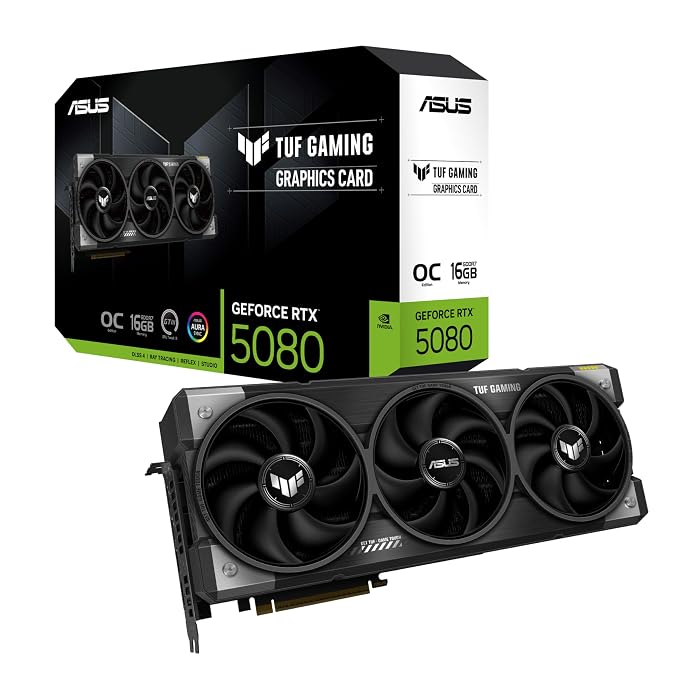
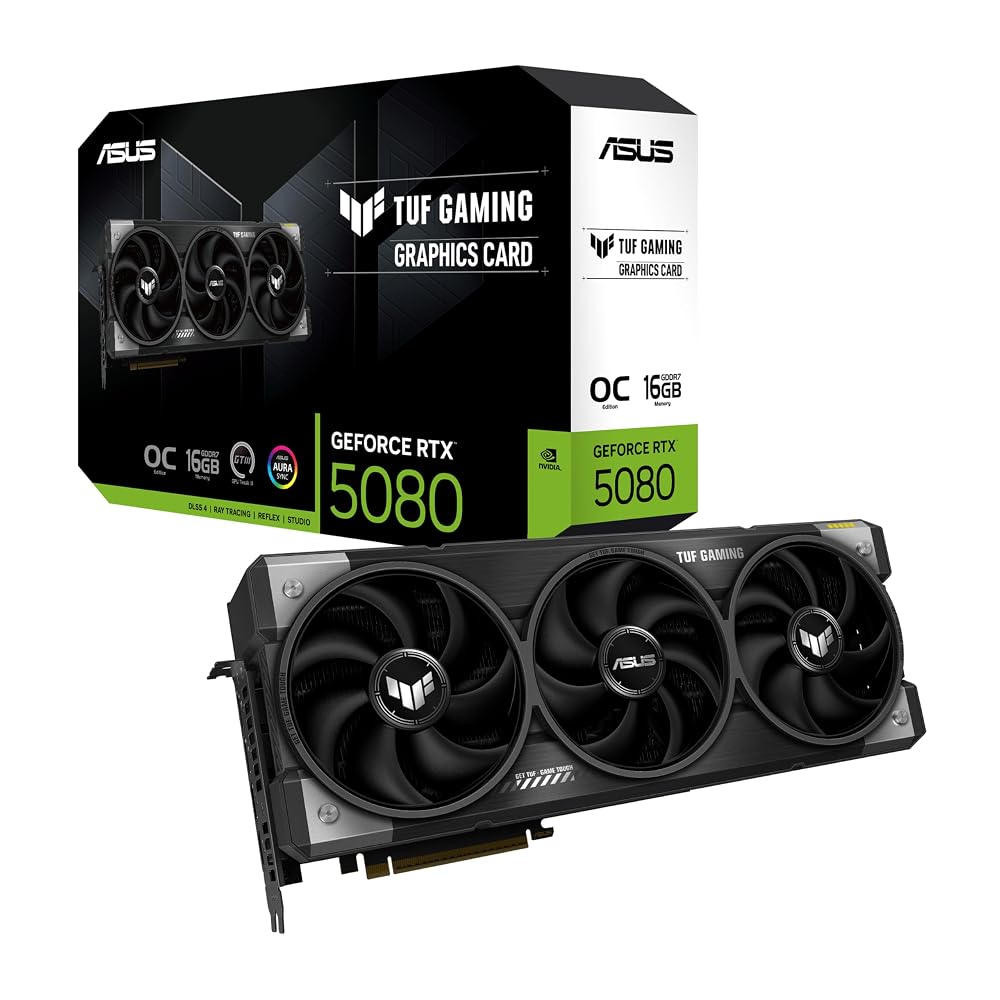
Sustained mobile workstation performance depends heavily on keeping component temperatures down, and asus tuf gaming rtx 5080 cooling accomplishes this through brute physical volume. The card employs an expansive 3.6-slot heatsink packed with dense fin stacks designed to shed heat rapidly. Airflow is driven across this array by three Axial-tech fans, which utilize dual-ball bearings and specialized outer rings to direct air deep into the heatsink without excessive turbulence.
Rather than utilizing standard thermal paste that can pump out or degrade over time under heavy thermal cycles, ASUS implements a specialized phase-change GPU thermal pad. This pad changes consistency under operational heat to fill microscopic surface imperfections between the GPU die and the cold plate. The phase-change pad helps ensure optimal thermal longevity and heat transfer over years of heavy operational loads, eliminating the routine maintenance usually needed to keep high-wattage GPUs operating at peak performance.
Ruggedized Physical Construction and Protective PCB Coating
Field editors and production crews often have to operate in uncontrolled environments where dust, workshop particulate, and fluctuating humidity can threaten expensive electronic components. The TUF Gaming series addresses this by applying a specialized protective PCB coating directly across the surface of the board. This barrier shields sensitive traces and solder points against short circuits caused by moisture, fine debris, and airborne contaminants encountered during transport or on-location production shoots.
Complementing this environmental barrier are military-grade components rated for long lifespans under intense thermal stress. These robust chokes, MOSFETs, and capacitors ensure rock-solid electrical delivery straight from the power supply, preventing voltage drops and thermal degradation. ASUS constructs the board using its proprietary Auto-Extreme automated manufacturing process, an automated single-pass soldering technique that eliminates human error, reduces thermal strain on parts during production, and avoids harsh cleaning chemicals.
Comprehensive Display Connectivity and High-End Power System
Display connectivity on this card goes well beyond standard multi-monitor outputs by integrating five native high-bandwidth ports. Content creators can utilize three native DisplayPort 2.1a ports alongside two native HDMI 2.1b connections, enabling a display maximum resolution of 7680 x 4320. This expansive array allows editors to configure dual 8K reference screens or elaborate multi-display editing suites without resorting to external display hub adapters or compromising refresh rates.
Powering this architecture requires an advanced electrical infrastructure, and users must carefully note the tuf rtx 5080 power requirements. The card mandates a minimum 850W power supply and relies strictly on a native 16-pin 12V-2×6 (12VHPWR) PCIe power connector. Mobile creators assembling custom rigs must ensure their compact power supplies include this dedicated high-amperage cable, avoiding loose multi-adapter dongles that crowd internal chassis space.
Automated Performance Profiling via GPU Tweak III
While the hardware is built for brute performance out of the box, managing thermal acoustics and energy consumption is essential when running inside mobile rigs. The hardware pairs natively with ASUS GPU Tweak III software, providing an intuitive interface for managing clock frequencies, voltage curves, and custom fan profiles. Users can easily toggle between the 2700 MHz Default mode and the 2730 MHz OC mode depending on whether the priority is pure rendering speed or lower acoustic output.
GPU Tweak III also offers real-time hardware monitoring, letting users track thermal junctions, fan duty cycles, and wattage draw across individual sub-systems. This level of granular software control allows editors to undervolt or dial back aggressive fan ramps when recording clean audio in temporary production offices, or open up the thermal envelope when burning through long render queues overnight.
Specs
| Graphics Coprocessor | NVIDIA GeForce RTX 5080 (Blackwell Architecture) |
|---|---|
| Video Memory | 16 GB GDDR7 |
| Memory Clock Speed | 2730 MHz |
| Boost Clock Speed | 2700 MHz (Default) / 2730 MHz (OC Mode) |
| Physical Dimensions | 13.7 inches Length x 5.7 inches Width (348 mm Length) |
| Form Factor and Weight | 3.6 Slots Width, 4.3 lbs (1.95 kg) |
| Bus Interface | PCI-Express x16 (PCIe 5.0) |
| Video Outputs | 3x Native DisplayPort 2.1a, 2x Native HDMI 2.1b |
| Maximum Display Resolution | 7680 x 4320 (8K) |
| Power Supply Requirement | Minimum 850W with 16-pin 12V-2×6 (12VHPWR) Connector |
| Included Hardware | TUF Graphics Card Holder, TUF Magnet, TUF Velcro Hook & Loop, User Manual |
Full spec sheet from the listing (31 entries)
| 0 | Graphics Coprocessor, NVIDIA GeForce RTX 5080 |
|---|---|
| 1 | Graphics Card Ram, 16 GB |
| 2 | GPU Clock Speed, 2730 megahertz |
| 3 | Video Output Interface, Native DisplayPort 2.1a x3, Native HDMI 2.1b x 2 |
| 4 | Graphics Ram Type, GDDR7 |
| 5 | Compatible Devices, Desktop |
| 6 | Graphics Card Interface, PCI-Express x16 |
| 7 | Memory Clock Speed, 2730 MHz |
| 8 | Number of Fans, 3 |
| 9 | GPU Series, NVIDIA RTX 50 Series |
| 10 | Display Maximum Resolution, 7680 x 4320 |
| 11 | Item Dimensions L x W, 13.7"L x 5.7"W |
| 12 | Item Highlight, PCIe 5.0, HDMI/DP 2.1, 3.6-slot, Military-grade Components, Protective PCB Coating, Axial-tech Fans |
| 13 | Brand, ASUS |
| 14 | Video Processor, NVIDIA |
| 15 | Antenna Location, Business, Gaming, Personal, Professional |
| 16 | Built-In Media, TUF Graphics card Holder, TUF Magnet, TUF Velcro Hook & Loop, TUF-RTX5080-O16G-GAMING, User manual |
| 17 | Model Name, TUF-RTX5080-O16G-GAMING |
| 18 | Graphics Description, NVIDIA GeForce RTX™ 5080 |
| 19 | Number of Packs, 1 |
| 20 | Manufacturer, ASUS |
| 21 | Number of Items, 1 |
| 22 | UPC, 197105868335 |
| 23 | Item Weight, 5 pounds |
| 24 | Model Number, TUF-RTX5080-O16G-GAMING |
| 25 | Mfr Part Number, TUF-RTX5080-O16G-GAMING |
| 26 | Warranty Description, 3 years |
| 27 | Best Sellers Rank, #9 in Computer Graphics Cards |
| 28 | ASIN, B0DQSMMCSH |
| 29 | Customer Reviews, 4.7 4.7 out of 5 stars (270) 4.7 out of 5 stars |
| 30 | Graphics Ram Size, 16 GB |
Quoted from the product listing, not measured by us.
ASUS TUF Gaming RTX 5080 Pros and Cons
Pros
- Ultra-fast 16GB GDDR7 memory architecture
- Protective PCB coating resists dust and moisture
- Massive 3.6-slot heatsink with phase-change pad
- Five native DisplayPort 2.1a and HDMI 2.1b outputs
- Included GPU anti-sag support bracket
Cons
- Huge 13.7-inch length limits portable case selection
- Hefty 4.3-pound weight risks transport slot strain
- Requires high-capacity 850W minimum power supply
Check ASUS TUF Gaming RTX 5080 on Amazon
Best Use Cases
- Transportable micro-ATX or mid-tower editing rigs deployed inside ruggedized flight cases for on-site multi-camera video production.
- Dedicated desktop editing suites requiring native triple DisplayPort 2.1a multi-monitor setups and heavy real-time 8K VFX rendering.
- Harsh production environments where airborne dust, moisture, and high ambient temperatures threaten sensitive desktop graphics hardware.
- Extended batch processing and overnight 3D rendering workflows that demand long-term thermal pad resilience without component degradation.
Before You Buy
Physical spatial requirements represent the single most important consideration before investing in this card. The listed asus tuf rtx 5080 dimensions measure 13.7 inches (348mm) in length and 5.7 inches in width, accompanied by an expansive 3.6-slot thickness and a total mass of 4.3 pounds. You must verify your 5080 tuf gaming clearance carefully, as standard small form factor cases and smaller micro-ATX desktop enclosures simply will not accommodate a card of this length and depth. Furthermore, because of the substantial weight, utilizing the included TUF graphics card holder is mandatory to eliminate strain on your motherboard’s PCIe x16 slot, especially if the PC tower will be transported in vehicles over rough roads.
Electrical configuration must also be verified well in advance. The card requires an 850-watt power supply unit equipped natively with a 16-pin 12V-2×6 power connection; running legacy daisy-chained 8-pin adapters inside tight chassis configurations creates cable clutter and airflow blockages. In terms of package contents, the retail box includes the TUF graphics card holder, a decorative TUF magnet, TUF velcro hook-and-loop straps, the card itself, and documentation. However, the listing does not specify the presence of any video cables, 12VHPWR power adapters, or supplementary chassis brackets, meaning you must provide your own high-bandwidth DisplayPort 2.1 or HDMI 2.1b cables to actually drive 8K displays.
How It Compares With Similar Picks
| Product | Best For | Key Difference |
|---|---|---|
| ASUS TUF Gaming RTX 5080 | Heavyweight content creation and rugged workstation durability | 16GB GDDR7, massive 3.6-slot design, protective PCB coating, 5 native video outputs. |
| GIGABYTE Radeon RX 9070 XT | PCIe 5.0 gaming and raster rendering setups | Uses 16GB GDDR6 memory and features standard desktop styling rather than military-grade physical reinforcements. |
| ASRock Radeon RX 9070 Challenger | Standard-profile desktop multi-display systems | Features a 2520MHz boost clock, triple fans with 0dB silent mode, and 16GB GDDR6 256-bit configuration. |
| PCIe 4.0 | Ultra-compact, low-power budget travel builds | 6GB GDDR6 memory, compact dual-fan profile, IP5X dust resistance, and minimal power consumption. |
Choosing an alternative depends heavily on your form factor constraints, display architecture, and software ecosystem. If your creative software relies strictly on AMD-optimized render paths or you want a standard dual-slot profile without the extreme 3.6-slot bulk of the TUF series, the ASRock or GIGABYTE cards provide modern PCIe 5.0 graphics using GDDR6 memory. For editors seeking an alternative NVIDIA build, comparing different board partner layouts such as an msi 5080 graphics card can reveal variations in overall length and cooler height. Meanwhile, if you are building an ultra-portable emergency editing box where space and thermal output must remain minimal, the compact ASUS Dual RTX 3050 offers modest performance in an easily transportable chassis.
Bottom Line
When asking whether the 5080 tuf gaming is worth it, the answer hinges entirely on the physical environment of your workstation. As detailed in the official 5080 tuf gaming specs, this card delivers top-tier workstation power, cutting-edge GDDR7 memory speeds, and unparalleled structural defenses against heat, dust, and continuous rendering fatigue. ASUS has engineered an exceptionally reliable piece of hardware that guarantees cool, silent, and stable computing for production editors who operate in high-pressure studio environments.
However, attempting to shoehorn this component into a 5080 tuf gaming portable workstation requires realistic planning. Weighing 4.3 pounds and measuring nearly 14 inches in length, it is virtually impossible to deploy inside minimalist luggage or ultra-compact travel chassis. If you require genuine backpack portability, pairing a high-end desktop base with a dedicated machine like the laptop gamer asus tuf f15 remains a vastly more practical strategy. But if your workflow accommodates a rugged travel flight case with space for a heavy-duty chassis, this graphics card stands as an unbeatable fortress of rendering performance.
FAQ
Can the ASUS TUF Gaming RTX 5080 fit inside a compact travel chassis?
In most traditional compact or small form factor enclosures, it will not fit. The card measures 13.7 inches (348mm) in length and requires 3.6 full expansion slots of vertical depth, meaning you will need a dedicated mid-tower case or a specialized transportable micro-ATX chassis designed specifically for oversized graphics cards.
What power supply and connector does this card require?
ASUS specifies a minimum 850-watt power supply unit to operate this graphics card. Additionally, your power supply must feature a native 16-pin 12V-2×6 (12VHPWR) power cable to provide stable voltage delivery directly to the board without relying on loose secondary adapters.
How does the phase-change thermal pad compare to traditional thermal paste?
Traditional thermal paste can experience pump-out, dry out, or lose thermal conductivity over prolonged periods of heavy heating and cooling cycles. The phase-change thermal pad transitions consistency under operational heat to maintain seamless thermal contact over years of continuous use, eliminating the need to take the cooler apart for maintenance.
Why does ASUS include an anti-sag graphics card holder in the box?
Because the card weighs 4.3 pounds (nearly 2 kilograms) and extends nearly 14 inches from the rear PCIe bracket, gravity exerts significant leverage on the motherboard slot. The included TUF graphics card holder supports the far corner of the shroud to prevent structural bending or PCB warping, which is especially critical when moving the computer between locations.
How many high-resolution monitors can this card support simultaneously?
The card features five native output ports: three Native DisplayPort 2.1a ports and two Native HDMI 2.1b ports. It can output at a maximum resolution of 7680 x 4320 (8K), allowing content creators to run high-refresh 4K or ultra-wide multi-monitor setups without requiring external splitting hardware.
How this site works
- 194reviews published
- 2,323products with a buyer rating
- 2,260products with listed features
- 84brands covered
Ratings, prices, stock and specifications are read from the Amazon product listing. We do not run lab tests of our own, so a score here is the average rating left by buyers, not a verdict from a test bench. We track one retailer, so prices here are not a comparison.