Air Quality Monitors Buying Guide (2026): What Matters and 8 Picks
Choose the right air quality monitor for your home. We compare 8 models based on sensor types, monitored parameters, and form factors to help you make an informed decision.
9 min read

Reviewed
Air Quality Monitors Buying Guide (2026): What Matters and 8 Picks
Price today
| Amazon | Not listed | View deal |
|---|
We track one retailer, so this is not a price comparison. Affiliate link; price and stock come from the listing and change without notice.
As Amazon Associates, we earn from qualifying purchases. This means we may receive a small commission at no extra cost to you if you click through and make a purchase.
As an Amazon Associate we earn from qualifying purchases. Links on this page are affiliate links.
This air quality monitor buying guide helps you choose the right device for your space. You will learn how to evaluate sensor types, monitored parameters, and form factors. The recommendations below are selected strictly from published specifications. We compare features like NDIR sensors, radon detection, and data logging capabilities. This approach ensures you make an informed decision based on technical performance rather than marketing claims.
You will decide which monitor fits your specific needs, whether you require long-term wireless CO2 tracking, portable formaldehyde detection, or dedicated radon monitoring. The list includes 8 picks ranked by their technical attributes. Each product is chosen for its ability to deliver precise data in home or office environments. You can compare dimensions, battery life, and connectivity options to find the best fit. Use this guide to match your indoor air quality goals with the right hardware.
Key Specs to Check Before Buying
Monitored parameters
You need a device that measures the specific pollutants in your environment. Some units focus only on CO2, while others track PM2.5, VOCs, or radon. If you live near industrial areas, particulate matter is critical. For new renovations, formaldehyde detection matters. The SAF Aranet4 tracks CO2, temperature, and humidity, making it ideal for office ventilation checks. The Airthings View Plus adds radon detection, which is vital for basement homes. Choose based on the health risks in your specific location. More parameters mean a more complex device, but also more relevant data for your daily decisions.
Look for
- List of specific pollutants
- Sensor accuracy range
- Calibration frequency
Sensor technology
The sensor type determines data reliability. NDIR sensors are the gold standard for CO2 because they are stable and do not degrade quickly over time. Laser scattering sensors are used for particulate matter and provide real-time particle counts. The BREATHE Airmonitor Plus Gen 2 uses an NDIR sensor for precise CO2 tracking. The Temtop LKC1000S uses industrial-grade sensors for formaldehyde and particles. Avoid devices with unknown or generic sensor types if you need professional-grade data. NDIR sensors are generally more expensive but offer better long-term consistency. Check if the device allows for sensor replacement or recalibration.
Look for
- NDIR for CO2
- Laser for particles
- Sensor brand name
Form factor
Decide if you need a stationary unit or a portable tool. Stationary monitors like the Qingping Gen 2 stay in one room to provide continuous historical data. Portable devices like the Temtop or MORPTRA allow you to move between rooms or test vehicles. Portability often means a larger battery or more frequent charging. The Ecosense plug-in radon detector is fixed but unobtrusive. Consider where you will place the device. A large display helps if you are in the room, while a small device fits in tight spaces. Your usage pattern dictates the form factor.
Look for
- Portable or fixed
- Display size
- Mounting options
Connectivity and app
Most modern monitors connect to Wi-Fi for remote viewing. This lets you check air quality from your phone while you are away. The Airthings View Plus and Qingping Gen 2 offer app access for historical data trends. Some portable devices may not have Wi-Fi but offer data logging via USB. The MORPTRA 16-in-1 has a color screen for local viewing. Determine if you need real-time alerts or just historical review. App quality varies, so check if the data export features meet your needs. Wi-Fi requires a stable network connection in the placement area.
Look for
- Wi-Fi or Bluetooth
- Data export format
- App stability
Power source
Power options affect placement flexibility. Battery-powered devices like the SAF Aranet4 offer four-year battery life, reducing maintenance. The Airthings View Plus is also battery-powered. Plug-in units like the Ecosense provide continuous power without charging. Portable devices often use rechargeable batteries, requiring frequent charging if used daily. Consider the convenience of changing batteries versus plugging in a charger. Long battery life is crucial for units placed in hard-to-reach spots. Check the battery type and replacement cost if not included.
Look for
- Battery or plug-in
- Battery lifespan
- Charging method
Size and weight
Physical dimensions determine where you can place the monitor. Small devices like the SAF Aranet4 (70x70x24 mm) fit on desks or shelves easily. Larger units like the YNAK 7-Inch Monitor take up more space but offer bigger displays. Weight matters for portable devices; the Temtop is over a pound, while the SAF is under four ounces. Consider the footprint in your room. A bulky device might be distracting in a bedroom. Check the dimensions to ensure it fits your intended location without obstructing airflow or views.
Look for
- Device dimensions
- Weight in ounces
- Footprint size
Build quality and display
The build quality affects durability, and the display affects readability. A clear screen helps you see readings instantly without using an app. The YNAK and MORPTRA devices feature larger color screens for detailed local data. The SAF Aranet4 has a smaller, simple display. Consider the material quality if the device is handled frequently. A robust build is better for portable units. Check if the display is always on or wakes up on movement. A high-resolution display provides better clarity for complex data sets.
Look for
- Screen resolution
- Material type
- Always-on option
Types of Air Quality Monitors
Stationary Home Monitors
Stationary monitors like the Qingping Gen 2 or BREATHE Airmonitor Plus Gen 2 stay in one place. They track multiple metrics such as PM2.5, CO2, and VOCs. These devices often include Wi-Fi for remote app access. You get detailed historical data and high-resolution displays. The trade-off is that you must keep them plugged in or charged. They are best for homes where you want continuous, unattended monitoring of your primary living spaces.
Portable Handheld Units
Portable units like the Temtop LKC1000S or MORPTRA 16-in-1 are lightweight and battery-powered. You can carry them to check air quality in different rooms or vehicles. They often detect specific chemicals like formaldehyde alongside particulate matter. The main advantage is flexibility. You can move them anywhere. The trade-off is smaller batteries and less comprehensive placement options. They suit users who need to verify air quality in specific spots rather than monitoring a whole room continuously.
Specialized Detectors
Specialized detectors focus on single parameters like radon or CO2. The Ecosense EB100W detects radon, while the SAF Aranet4 tracks CO2 with NDIR sensors. These devices offer high precision for their specific target. They often have long battery lives, lasting years. The trade-off is that they do not measure other pollutants like dust or VOCs. You need these if you have a specific concern, such as basement radon or office ventilation, rather than general air quality awareness.
Avoid These Air Quality Monitor Mistakes
Placing the unit in a corner or behind furniture
Place the monitor in a corner or behind furniture. Airflow is restricted there, leading to inaccurate readings. Position the device in an open area at breathing height. This ensures you capture the true air quality of the room you occupy.
Assuming all sensor types provide equal accuracy
Assume all sensors are equal. Electrochemical sensors for VOCs often drift over time. Look for devices with NDIR CO2 sensors for accuracy. Check the manufacturer's calibration instructions. Regular maintenance keeps your data reliable and your health decisions sound.
Overlooking the sensor update frequency or refresh rate
Ignore the update frequency. A slow refresh rate misses sudden pollution spikes. Choose a monitor with a high sampling rate. This allows you to react quickly to cooking fumes or cleaning products. Real-time data is essential for effective air management.
Relying only on the local display without app access
Rely solely on the display. You may not always be near the device. Select a monitor with Wi-Fi connectivity. This lets you check levels from your phone. Remote alerts help you address issues even when you are in another room.
Skipping the initial CO2 sensor calibration process
Forget to calibrate the CO2 sensor. Factory settings may not match your home. Manual calibration ensures accurate baselines. Check if the device supports auto-calibration. Proper setup prevents false alarms and ensures the readings reflect your actual indoor environment.
| # | Product | Best for | Price |
|---|---|---|---|
| 1 | SAF Aranet4 Wireless CO2 Monitor | Long-term wireless CO2 monitoring | |
| 2 | Airthings View Plus Radon & Air Quality Monitor | Battery-powered radon and air quality tracking | |
| 3 | Temtop Handheld Formaldehyde and Particle Counter | Formaldehyde detection and historical data logging | |
| 4 | MORPTRA 16-in-1 Portable Air Quality Monitor | Multi-parameter air testing in portable settings | |
| 5 | BREATHE Airmonitor Plus Gen 2 Wi-Fi Monitor | detailed indoor air quality tracking | |
| 6 | YNAK 7-Inch Indoor Air Quality Monitor | Portable multi-parameter air quality tracking | |
| 7 | Qingping Gen 2 Wi-Fi Touchscreen Air Monitor | detailed seven-metric monitoring with remote app access | |
| 8 | Ecosense Digital Plug-In Radon Detector | Dedicated radon monitoring in homes |
SAF Aranet4 Wireless CO2 Monitor
Best for: Long-term wireless CO2 monitoring
- Monitored Parameters
- CO2, temperature, humidity, pressure
- Sensor Type
- NDIR
- Connectivity
- Wireless
- Power Source
- Battery
- Display Type
- E-ink
- Alert Method
- Buzzer, color coding
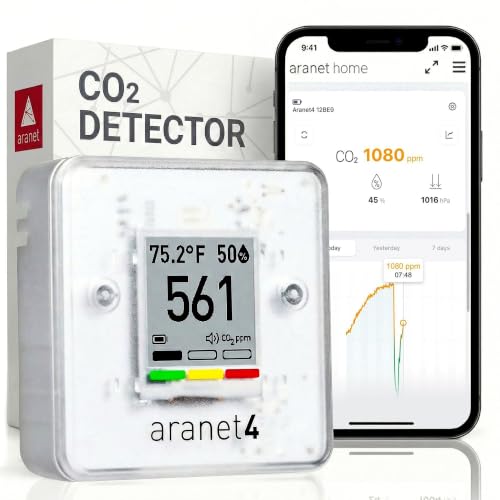
The Aranet4 is a wireless indoor air quality monitor that tracks carbon dioxide, temperature, humidity, and atmospheric pressure. It uses a precise NDIR sensor for reliable CO2 readings. The e-ink display runs on a single battery for up to four years. A companion app stores up to 90 days of historical data. This compact unit suits home or office use where long-term, cable-free monitoring is preferred.
- Four-year battery life with e-ink display
- NDIR sensor for precise CO2 measurement
- Tracks CO2, temperature, humidity, and pressure
- App provides 90 days of historical data
- Measures only four parameters while competitors offer up to 18
- Stores only 90 days of data history
- Weighs 3.67 ounces, heavier than some lighter monitors
- You want a wireless unit with a four-year battery
- You need precise NDIR CO2 readings
- You prefer a compact device for home or office
- You need to monitor more than four air quality parameters
- You require local data storage exceeding 90 days
- You prefer a plug-in device without battery maintenance
Verdict: The Aranet4 Indoor CO2 Monitor delivers precise NDIR CO2 tracking with a four-year battery life. It fits users who want reliable, wireless monitoring for their home or office without frequent charging.

Airthings View Plus Radon & Air Quality Monitor
Best for: Battery-powered radon and air quality tracking
- Monitored Parameters
- Radon, PM2.5, CO2, VOCs, RH, temp, Pa
- Sensor Type
- Electrochemical
- Power Source
- Battery-powered
- Display Type
- e-Ink screen
- Alert Method
- App notifications
- Data Logging
- Cloud storage via app
The Airthings View Plus is a battery-powered monitor that tracks radon, PM2.5, CO2, VOCs, humidity, temperature, and pressure. Its eInk screen and cable-free design allow flexible placement. You get live data via the Airthings app, which requires an account and internet connection. This device suits those prioritizing radon detection and portable, wired-free monitoring in their home.
- Measures radon gas, PM2.5, CO2, VOCs, humidity, temperature, and pressure
- Battery-powered for cable-free placement
- Customizable eInk screen display
- Five-year warranty available upon registration
- Requires the Airthings app and an internet connection to function
- Heavier at 5.76 ounces compared to many lightweight wall-mounted monitors
- You need to test for radon gas levels
- You want a monitor that does not require hardwiring
- You prefer an eInk display for low power usage
- You cannot maintain a constant Wi-Fi connection
- You want a device that works without creating an app account
- You prefer a color LCD screen over eInk
Verdict: Airthings View Plus Battery Air Monitor fits homeowners who need reliable radon detection and flexible placement without wiring. It delivers comprehensive air quality data through its app, provided you have internet access.

Temtop Handheld Formaldehyde and Particle Counter
Best for: Formaldehyde detection and historical data logging
- Monitored Parameters
- PM2.5, PM10, HCHO, RH, temp, AQI
- Sensor Type
- Laser particle, electrochemical
- Display Type
- TFT screen
- Alert Method
- 6-level color indicator
- Data Logging
- Local memory (3 months)
- Features
- Air Quality Monitor
This portable unit measures PM2.5, PM10, formaldehyde, humidity, and temperature. It features industrial-grade laser particle sensors with a 20,000-hour lifespan. The device stores three months of continuous data for export. A large TFT screen displays a six-level health indicator. It suits users needing detailed historical air quality tracking and formaldehyde detection in their home environment.
- Measures PM2.5, PM10, formaldehyde, humidity, and temperature
- Stores up to three months of continuous data
- Industrial-grade laser sensor lasts up to 20,000 hours
- Large TFT screen with six-level health indicator
- Weighs 1.04 pounds, making it heavier than many compact monitors
- Dimensions of 5.98 by 8.82 by 1.93 inches require more counter space
- Limited to 4 measurement parameters compared to 16-in-1 competitors
- You need to track formaldehyde levels alongside particulate matter
- You want to export historical air quality data for analysis
- You prefer a device with a large, easy-to-read display
- You require monitoring of radon or TVOC levels
- You need a battery-powered unit for portability without a power source
- You prefer a smaller device with fewer than five monitored parameters
Verdict: Temtop LKC1000S 2nd Professional Air Quality Monitor fits users who prioritize formaldehyde detection and long-term data logging. Its industrial sensors and clear display make it a solid choice for detailed indoor air analysis.

MORPTRA 16-in-1 Portable Air Quality Monitor
Best for: Multi-parameter air testing in portable settings
- Monitored Parameters
- PM1.0, PM2.5, PM10, TVOC, HCHO
- Power Source
- Rechargeable battery, AC adapter
- Display Type
- HD color screen
- Alert Method
- Audio prompt, color-coded readings
- Features
- Air Quality Monitor
- Form Factor
- Portable
The MORPTRA 16-in-1 Indoor Air Quality Monitor tracks seven core indicators, including PM1.0, PM2.5, PM10, TVOC, and HCHO. It updates data every 1.5 seconds on an HD color screen. The device runs for 4-5 hours on a full charge via Type-C. Its compact, portable design fits homes, offices, and vehicles. This unit suits users who want comprehensive multi-parameter tracking in a lightweight, easy-to-use form factor.
- Tests 7 core indicators including PM2.5, TVOC, and HCHO
- Updates air data every 1.5 seconds for real-time monitoring
- Features an HD color screen with color-coded air level readings
- Includes adjustable audio prompts and a quiet sampling mode
- Portable design with Type-C fast charging and AC adapter
- Battery life is limited to 4-5 hours of continuous use
- Weighs 14.4 ounces, making it heavier than some competitors
- Warranty is 12 months, which is shorter than the 18-month standard on other picks
- You need to monitor formaldehyde and TVOC levels alongside particulate matter
- You want a portable unit for use in cars or offices
- You prefer a large, color-coded display for easy reading
- You require a device that lasts multiple days on a single charge
- You are looking for a lightweight monitor under 10 ounces
- You need a longer warranty period than 12 months
Verdict: The MORPTRA 16-in-1 Indoor Air Quality Monitor fits users who need detailed chemical and particle data in a portable, color-screen device. It is ideal for tracking indoor air quality in small spaces like offices or vehicles where frequent charging is manageable.

BREATHE Airmonitor Plus Gen 2 Wi-Fi Monitor
Best for: detailed indoor air quality tracking
- Monitored Parameters
- CO2, PM1, PM2.5, PM10, TVOC, HCHO, RH
- Sensor Type
- NDIR, laser particle sensor
- Connectivity
- 2.4 GHz Wi-Fi
- Power Source
- Rechargeable battery, USB-C
- Display Type
- Color display
- Alert Method
- App alerts
The BREATHE Airmonitor Plus Gen 2 measures CO2, PM1, PM2.5, PM10, TVOC, and formaldehyde. It uses a professional-grade NDIR sensor for accurate CO2 readings. The device connects via 2.4 GHz Wi-Fi to the Breathe Tech app for remote monitoring. You can view 90 days of history and export data. It features a 6-hour battery for portable use and a compact 2.8-inch width.
- Professional-grade NDIR CO2 sensor
- Measures 8 parameters including PM2.5 and formaldehyde
- 90-day app data history and export
- 6-hour portable battery life
- 2.4 GHz Wi-Fi connectivity
- 6-hour battery life limits portable use
- Small 2.8-inch width may reduce display visibility
- Requires 2.4 GHz Wi-Fi network
- You need professional-grade NDIR CO2 accuracy
- You want to track formaldehyde and VOC levels
- You prefer exporting data for long-term analysis
- You require 5 GHz Wi-Fi support
- You need a larger display than 2.8 inches
- You want all-day battery life without charging
Verdict: BREATHE Airmonitor Plus Gen 2 suits users who need precise NDIR CO2 monitoring and formaldehyde detection with detailed historical data export capabilities.

YNAK 7-Inch Indoor Air Quality Monitor
Best for: Portable multi-parameter air quality tracking
- Monitored Parameters
- CO2, PM1.0, PM2.5, PM10, HCHO, TVOC
- Sensor Type
- True NDIR
- Power Source
- Built-in 5000mAh battery
- Display Type
- 7-inch color TFT
- Data Logging
- 24-hour & 15-day trend history
- Features
- Air Quality Monitor
This YNAK monitor tracks eighteen parameters, including CO2 via True NDIR, PM2.5, and formaldehyde. It features a large 7-inch TFT display and records 24-hour or 15-day history. You can move it between rooms using the 5000mAh battery, which lasts up to 8 hours. The device switches themes automatically for day or night viewing.
- True NDIR CO2 sensor for reliable readings
- 7-inch TFT display with color-coded alerts
- Records 24-hour and 15-day trend history
- 5000mAh battery supports up to 8 hours of use
- Battery life is limited to 8 hours
- Requires frequent recharging for continuous use
- No mention of mains power adapter included
- You need portable monitoring between rooms
- You want long-term trend history
- You prefer a large visual display
- You require continuous plug-in operation
- You need data logging beyond 15 days
- You prefer small desktop monitors
Verdict: YNAK 18-in-1 Indoor Air Quality Monitor suits users who need portable, multi-parameter tracking with a clear display. It fits those who value historical data over all-day battery life.

Qingping Gen 2 Wi-Fi Touchscreen Air Monitor
Best for: detailed seven-metric monitoring with remote app access
- Monitored Parameters
- Temp, RH, CO2, PM2.5, PM10, eTVOC, noise
- Connectivity
- 2.4 GHz / 5 GHz Wi-Fi
- Power Source
- Rechargeable battery, USB
- Display Type
- 4-inch IPS touchscreen
- Alert Method
- Color indicator
- Data Logging
- 30-day app history export
The Qingping Air Quality Monitor Gen 2 tracks seven indoor metrics, including CO2, PM2.5, PM10, temperature, humidity, eTVOC, and noise. It features a 4-inch high-resolution touchscreen and connects to Wi-Fi for remote monitoring via the Qingping+ app. The device stores 30 days of history and supports firmware updates. Its replaceable PM sensor simplifies long-term maintenance. This unit suits users who want detailed local data and remote access in a compact form factor.
- Monitors seven metrics including CO2, PM2.5, PM10, temperature, humidity, eTVOC, and noise
- Features a 4-inch IPS touchscreen with 254 PPI resolution
- Supports 2.4GHz and 5GHz Wi-Fi for remote app monitoring
- Replaceable PM sensor allows for easy future maintenance
- Stores and exports 30 days of historical data
- Battery backup lasts only up to 3 hours on a full charge
- Does not measure formaldehyde levels
- Requires constant USB power input for daily operation
- You want to monitor noise levels alongside standard air quality metrics
- You prefer a high-resolution touchscreen for local data viewing
- You need remote monitoring via a dedicated app with history export
- You require formaldehyde detection capabilities
- You need a device that operates independently without a power adapter
- You prefer a smaller screen size than 4 inches
Verdict: Qingping Air Quality Monitor Gen 2 offers comprehensive seven-metric tracking and a high-resolution display for users who value detailed local and remote air quality insights. It fits best in spaces where noise monitoring and sensor maintainability are priorities.

Ecosense Digital Plug-In Radon Detector
Best for: Dedicated radon monitoring in homes
- Monitored Parameters
- Radon
- Sensor Type
- Ion chamber
- Power Source
- Power adapter
- Display Type
- Digital display
- Color
- White
- Placement
- Home
This plug-in radon monitor tracks indoor air quality with a 10-minute update cycle. It features a full-size digital display showing real-time, daily, weekly, monthly, and long-term averages. The compact white unit measures 2.83 by 2.44 inches and weighs 12 ounces. It suits homeowners who want continuous radon monitoring without complex setup. You get a table stand and power adapter included for immediate use.
- 10-minute measurement updates for fast readings
- Displays real-time and long-term average levels
- Compact size at 2.83 inches wide
- Includes table stand and power adapter
- Measures only radon, not other pollutants
- Battery power may affect accuracy
- 12-month warranty is shorter than competitors
- You need dedicated radon tracking
- You prefer plug-in operation over batteries
- You want simple real-time data display
- You need CO2 or PM2.5 monitoring
- You want multi-gas detection
- You require a longer warranty period
Verdict: Ecosense EB100W Radon Detector is a focused tool for homes needing specific radon tracking. It fits buyers who prioritize rapid updates and dedicated monitoring over comprehensive air quality analysis.
Specifications side by side
| Spec | SAF Aranet4 Wireless CO2 Monitor | Airthings View Plus Radon & Air Quality Monitor | Temtop Handheld Formaldehyde and Particle Counter | MORPTRA 16-in-1 Portable Air Quality Monitor | BREATHE Airmonitor Plus Gen 2 Wi-Fi Monitor | YNAK 7-Inch Indoor Air Quality Monitor | Qingping Gen 2 Wi-Fi Touchscreen Air Monitor | Ecosense Digital Plug-In Radon Detector |
|---|---|---|---|---|---|---|---|---|
| Monitored Parameters | CO2, temperature, humidity, pressure | Radon, PM2.5, CO2, VOCs, RH, temp, Pa | PM2.5, PM10, HCHO, RH, temp, AQI | PM1.0, PM2.5, PM10, TVOC, HCHO | CO2, PM1, PM2.5, PM10, TVOC, HCHO, RH | CO2, PM1.0, PM2.5, PM10, HCHO, TVOC | Temp, RH, CO2, PM2.5, PM10, eTVOC, noise | Radon |
| Sensor Type | NDIR | Electrochemical | Laser particle, electrochemical | – | NDIR, laser particle sensor | True NDIR | – | Ion chamber |
| Connectivity | Wireless | – | – | – | 2.4 GHz Wi-Fi | – | 2.4 GHz / 5 GHz Wi-Fi | – |
| Power Source | Battery | Battery-powered | – | Rechargeable battery, AC adapter | Rechargeable battery, USB-C | Built-in 5000mAh battery | Rechargeable battery, USB | Power adapter |
| Display Type | E-ink | e-Ink screen | TFT screen | HD color screen | Color display | 7-inch color TFT | 4-inch IPS touchscreen | Digital display |
| Alert Method | Buzzer, color coding | App notifications | 6-level color indicator | Audio prompt, color-coded readings | App alerts | – | Color indicator | – |
| Data Logging | App (up to 90 days) | Cloud storage via app | Local memory (3 months) | – | 90-day app history, CSV export | 24-hour & 15-day trend history | 30-day app history export | – |
| Features | Air Quality Monitor | Air Quality Monitor | Air Quality Monitor | Air Quality Monitor | Air Quality Monitor | Air Quality Monitor | Air Quality Monitor | – |
| Form Factor | – | – | Portable | Portable | – | – | – | – |
| Monitored Parameter | Humidity, Temperature, CO2 | Humidity, Temperature, CO2, VOC, Radon | PM2.5, Humidity, Temperature, PM10, Formaldehyde | – | PM2.5, CO2, VOC, PM10, Formaldehyde | PM2.5, Humidity, Temperature, CO2, VOC, PM10, Formaldehyde | PM2.5, Humidity, Temperature, CO2, PM10 | Radon |
| Color | White | White | Black/Orange | Terracotta Orange | White | History Tracking & White | White | White |
| Placement | Home, Office | – | – | Home, Office | – | – | Home, Bedroom | Home |
| Dimensions | 2.76 × 2.76 × 0.94 inches | 6.69 × 3.54 × 1.18 inches | 1.93 × 5.98 × 8.82 inches | – | 1.4 × 2.8 × 3.3 inches | – | 5.71 × 4.72 × 3.22 inches | 2.83 × 2.83 × 2.44 inches |
| Weight | 3.67 ounces | 5.76 ounces | 1.04 pounds | 14.4 ounces | 4 ounces | – | – | 12 ounces |
| Size | 70x70x24 mm / 2.76×2.76×0.94 inches | – | LKC-1000S 2nd(PM2.5, PM10, HCHO, AQI) | – | – | Standard | – | small |
| Model | TDSPC003.001 | 2960 | LKC-1000S 2nd | – | BTL40001 | WBA02-NEW | CGS2 | EB100W |
If you need dedicated tracking hardware, the indoor air quality meter buying guide outlines standalone sensor specifications.
Frequently asked questions
What is the difference between NDIR and non-NDIR CO2 sensors?
NDIR sensors use infrared light to measure carbon dioxide levels with high precision and stability. Non-NDIR sensors often rely on electrochemical methods that may drift over time. The SAF Aranet4 and BREATHE Airmonitor Plus Gen 2 both use NDIR technology. This ensures you get reliable long-term tracking for your home or office without frequent recalibration.
Do I need a monitor that detects radon?
Radon is a radioactive gas that can accumulate in homes, particularly in basements. If you live in an area with high radon potential, a dedicated detector is essential. The Airthings View Plus and Ecosense EB100W specifically track radon levels. Standard monitors focusing only on PM2.5 or CO2 will not detect this invisible health risk.
Which air quality monitor is best for detecting formaldehyde?
Formaldehyde is a volatile organic compound often released by new furniture or building materials. The Temtop LKC1000S 2nd and BREATHE Airmonitor Plus Gen 2 include specific sensors for HCHO. These devices help you identify spikes in indoor chemical levels. You can track historical data to see when ventilation is needed to clear the air.
Can I use an air quality monitor in my car?
Portable units are designed for flexible placement, including vehicles. The MORPTRA 16-in-1 and Temtop LKC1000S 2nd are compact handheld devices. They fit easily on dashboards or seats. You can monitor PM2.5, temperature, and VOCs while driving. This helps you assess air quality in small, enclosed spaces where ventilation is limited.
How important is Wi-Fi connectivity for an air monitor?
Wi-Fi allows you to view data remotely via a smartphone app. The Qingping Gen 2 and BREATHE Airmonitor Plus Gen 2 offer this feature. You can check air quality trends from anywhere. This is useful for tracking long-term patterns or verifying air quality when you are not at home. Some models require internet access for full functionality.
What parameters should I look for in a home monitor?
Your choice depends on your specific concerns. Common parameters include PM2.5, CO2, humidity, and temperature. The Qingping Gen 2 tracks seven metrics, including PM2.5 and CO2. If you worry about pollutants from cooking or cleaning, VOCs are also critical. Select a device that measures the specific contaminants present in your living space.
Is a large display better for reading air quality?
Larger screens make data easier to read from a distance. The YNAK 18-in-1 features a 7-inch display for clear visibility. The Qingping Gen 2 also offers a high-resolution touchscreen. These displays show real-time values for multiple pollutants. You can quickly assess air quality without needing to open an app or hold the device close.
See also
How this site works
- 822reviews published
- 2,323products with a score
- 2,260products with listed features
- 84brands covered
Prices, stock and specifications are read from the Amazon product listing. We do not run lab tests of our own; scores are out of 10, based on listed specifications and buyer feedback, not a verdict from a test bench. We track one retailer, so prices here are not a comparison.


