Bambu Lab A1 Mini Combo: Multi-Color 3D Printing for Mobile Makers
3D printing enthusiasts and remote fabricators frequently struggle to balance the creative flexibility of multi-material fabrication with physical portability. Traditional workshop printers often feature bulky frames, complex wiring, and sensitive manual leveling mechanisms that make transporting hardware between workspaces impractical. The Bambu Lab A1 Mini addresses these logistical hurdles by packaging automated multi-filament capabilities into…
8 min read




Reviewed
Bambu Lab A1 Mini
Our score
Well liked
Based on listed specifications — not from testing of our own.
Price today
| Amazon | Not listed | View deal |
|---|
- Prime eligible
- Sold by Bambu Lab Store, shipped by Amazon
We track one retailer, so this is not a price comparison. Affiliate link; price and stock come from the listing and change without notice.
What you need to know
- This unlocks dependable Bambu Lab A1 Mini multi-color printing, making it straightforward to create color-coded mechanical prototypes, decorative items, and… Bambu Lab A1 Mini Features Explained
- Mobile design offices where on-demand rapid prototyping requires fast 10,000 mm/s² acceleration without manual calibration overhead. Best Use Cases
- The main printer unit measures 16.77 inches deep, 14.82 inches wide, and 19.5 inches high, and weighs 10 kg. Before You Buy
- Alternatively, if you need a defined 220x220x220mm build envelope and high 280°C nozzle capabilities for single-filament tasks, the FLASHFORGE Adventurer 5M 3D… How It Compares With Similar Picks
- With its 10,000 mm/s² acceleration, full-auto calibration, active flow rate compensation, and automated AMS lite multi-filament management, it removes the… Bottom Line
One line lifted from each section below — follow the link to read that section in full.
As Amazon Associates, we earn from qualifying purchases. This means we may receive a small commission at no extra cost to you if you click through and make a purchase.
3D printing enthusiasts and remote fabricators frequently struggle to balance the creative flexibility of multi-material fabrication with physical portability. Traditional workshop printers often feature bulky frames, complex wiring, and sensitive manual leveling mechanisms that make transporting hardware between workspaces impractical. The Bambu Lab A1 Mini addresses these logistical hurdles by packaging automated multi-filament capabilities into a desktop-friendly chassis, enabling creators to deploy a functional prototyping studio in mobile offices, temporary event spaces, or space-constrained workrooms.
When evaluating whether the Bambu Lab A1 Mini is worth it for traveling makers and desktop hobbyists, the combination of automated setup and multi-filament management stands out immediately. With high-speed motion hardware, automated sensor routines, and an out-of-the-box build that requires only brief assembly, this machine bridges the gap between portable utility and automated multi-color production without requiring tedious hands-on calibration.
Quick Verdict
The Bambu Lab A1 Mini delivers an accessible and dependable multi-color printing workflow suited for tight desktop spaces and transportable workstations. While its 10 kg metal build requires deliberate handling when moving between locations, its hands-off calibration routines and responsive motion components eliminate typical operational friction.
- High-speed motion system reaching acceleration rates up to 10,000 mm/s² for swift part completion.
- Automated multi-color printing powered by the synchronized AMS lite feeding unit.
- Full-auto calibration handling critical bed leveling and Z-offset measurements automatically.
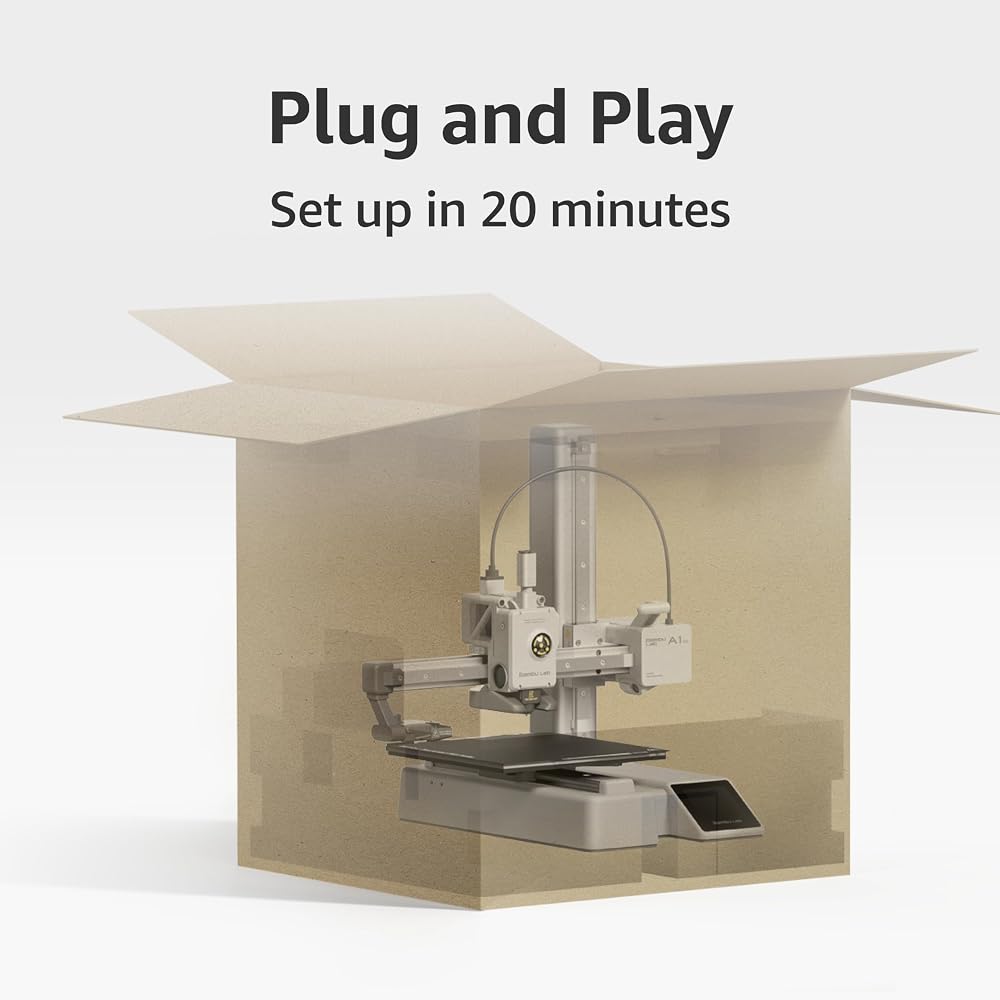
- Pre-assembled architecture enabling users to begin printing within roughly 20 minutes.
Bambu Lab A1 Mini Features Explained
Multi-Color Printing with AMS Lite
A primary capability of this platform is automated filament handling through the external AMS lite module. Instead of pausing prints and manually feeding different filament strands to achieve contrasting colors, the system coordinates automated material feeding during execution. This unlocks dependable Bambu Lab A1 Mini multi-color printing, making it straightforward to create color-coded mechanical prototypes, decorative items, and high-visibility components directly on your work surface.
Managing multiple filament paths requires organized desktop real estate, especially when running CAD software on compact workstations like a bosgame m5 ai mini desktop alongside your fabrication equipment. The AMS lite unit interfaces directly with the printer, feeding each filament strand through dedicated lines to maintain accurate color transitions across multi-hued models without manual spool swapping.
High-Speed Precision and Acceleration
Rapid fabrication is crucial when managing short turnaround cycles outside of a dedicated workshop. The motion platform on this unit achieves an impressive acceleration rate of up to 10,000 mm/s², allowing the printhead to reach peak operational velocity rapidly across short travel vectors. This rapid movement cuts down overall printing times substantially compared to standard Cartesian bedslingers, keeping project timelines on track.
Operating at extreme acceleration can sometimes introduce surface artifacts, ghosting, or dimensional inaccuracies on exterior walls. However, the machine relies on an all-metal chassis to maintain structural rigidity during rapid direction changes. This stiff construction absorbs mechanical inertia, ensuring that fine details, crisp sharp corners, and tight mechanical tolerances remain consistent across high-speed jobs.
Full-Auto Calibration Routine
Moving fabrication equipment between desks or traveling to collaborative workspaces often knocks mechanical components out of alignment. The Bambu Lab A1 Mini auto calibration system completely eliminates the tedious process of manual bed leveling by performing automatic Z-offset calculations and multi-point bed leveling before each print cycle. This automated routine ensures optimal first-layer adhesion without relying on manual adjustment thumbscrews or paper gauge checks.
Because the platform takes care of all calibration steps electronically, users avoid the common adhesion failures and nozzle scraping issues that often impact portable setups. Makers who check on build progress from a mobile device such as an ipad mini 17 can initiate jobs with confidence that the machine will autonomously configure its baseline parameters before laying down molten material.
Active Flow Rate Compensation
Extrusion consistency is vital for achieving structural strength and clean visual surfaces on finished parts. The Bambu Lab A1 Mini active flow rate compensation feature employs a dedicated algorithm that actively monitors extrusion metrics and adjusts the feeder motor output in real time. By compensating for dynamic pressure changes inside the melt zone, this system prevents under-extrusion gaps during acceleration and avoids over-extrusion bulges when decelerating around tight corners.
This automated flow regulation guarantees that layer lines remain smooth and solid infill planes stay uniformly flat throughout the duration of a job. Regardless of whether you are executing wide structural base layers or delicate surface details, the algorithm maintains balanced material flow across varying toolhead speeds.
Easy Pre-Assembled Setup and 1-Clip Quick Swap Nozzle
Time spent building a kit printer is time lost on project fabrication. The pre-assembled architecture streamlines the Bambu Lab A1 Mini combo setup, allowing creators to unbox the components, connect the cabling, and begin running their initial print within approximately 20 minutes. Operation is further simplified by an intuitive, simplified touchscreen interface that guides users through initial network setup and filament loading.
Routine hotend maintenance and nozzle swaps are equally straightforward thanks to the Bambu Lab A1 Mini quick swap nozzle assembly. Held in place by a single clip, the nozzle mechanism can be swapped out quickly without tools, complex disassembly, or fiddling with fragile hotend wiring harnesses. This streamlined design ensures minimal operational downtime whenever maintenance is required.
Specs
| Brand | BAMBULAB |
|---|---|
| Model Number | PF002-M+SA005-AU |
| Product Dimensions | 16.77"D x 14.82"W x 19.5"H |
| Item Weight | 10 kg |
| Construction Material | Metal |
| Color Finish | Silver |
| Max Acceleration | 10,000 mm/s² |
| Nozzle Type | 1-Clip Quick Swap Nozzle |
| Assembly State | Pre-assembled (20-minute setup) |
| Manufacturer | Shenzhen Tuozhu Technology Co., Ltd |
Quoted from the product listing, not measured by us.
Bambu Lab A1 Mini Pros and Cons
Pros
- High 10,000 mm/s² acceleration for swift fabrication
- Automated multi-color printing via AMS lite
- Full-auto calibration with automated Z-offset
- Active flow rate compensation for smooth extrusion
- Pre-assembled frame with 20-minute setup
- Convenient 1-clip quick swap nozzle mechanism
Cons
- Heavier 10 kg weight for frequent travel
- Build volume not specified in the listing
- External AMS lite requires additional desk space
Check Bambu Lab A1 Mini on Amazon
Best Use Cases
- Mobile design offices where on-demand rapid prototyping requires fast 10,000 mm/s² acceleration without manual calibration overhead.
- Automated multi-color modeling projects requiring coordinated color changes without stopping to swap filament spools manually.
- Small production workshops and apartment desks where equipment footprint must remain compact alongside computing hardware.
- Classroom demonstration setups where 20-minute initial assembly and touchscreen controls help beginners start printing quickly.
Before You Buy
Before bringing this system into your workflow, consider how its physical footprint fits your intended workspace. The main printer unit measures 16.77 inches deep, 14.82 inches wide, and 19.5 inches high, and weighs 10 kg. Optimizing the Bambu Lab A1 Mini for small spaces requires planning additional desk clearance for the AMS lite feeding unit, which sits externally to supply filament spools into the extruder. Ensuring sufficient clearance above and around the chassis prevents filament feed lines from binding during high-speed movements.
It is equally important to examine what the listing does not specify regarding technical capabilities. While the manufacturer highlights high-speed acceleration, an all-metal chassis, and silver styling, the listing does not specify the maximum build volume dimensions, maximum hotend temperatures, or supported material types like ABS or PETG. Additionally, users who plan to capture print time-lapses with miniature recording devices like an i3 4k thumb action camera will need to source their own external mounting hardware, as camera accessories are not listed as included in the box.
How It Compares With Similar Picks
| Product | Best For | Key Difference |
|---|---|---|
| Bambu Lab A1 Mini | Compact multi-color desktop fabrication | Pre-assembled compact metal chassis with 10,000 mm/s² acceleration and AMS lite support |
| MakerWorld Model Library | Enclosed CoreXY multi-color production | Full-sized enclosed CoreXY Bambu Lab P1S Combo including standard AMS unit |
| FLASHFORGE Adventurer 5M 3D Printer | High-speed single-material parts | CoreXY structure with 600mm/s speed, 280°C direct extruder, and 220x220x220mm print size |
| Beginner-Friendly Ecosystem with MakerWorld Model | Enclosed single-filament precision builds | Enclosed CoreXY P1S architecture designed for high-speed precision FDM printing |
Selecting between these machines depends largely on your enclosure needs and build volume requirements. If your projects involve sensitive technical materials that demand a draft-free environment, stepping up to the MakerWorld Model Library combo provides an enclosed CoreXY architecture with a full AMS unit, while the Beginner-Friendly Ecosystem with MakerWorld Model offers an enclosed CoreXY solution for single-material workflows. Alternatively, if you need a defined 220x220x220mm build envelope and high 280°C nozzle capabilities for single-filament tasks, the FLASHFORGE Adventurer 5M 3D Printer serves as a capable alternative. However, for mobile creators looking for an open-frame, multi-color desktop solution, choosing a portable 3D printer like the Bambu Lab A1 Mini delivers unmatched convenience.

Bottom Line
The Bambu Lab A1 Mini Combo delivers a refined balance of speed, convenience, and multi-color printing capability. With its 10,000 mm/s² acceleration, full-auto calibration, active flow rate compensation, and automated AMS lite multi-filament management, it removes the mechanical roadblocks that traditionally complicate 3D printing. The 20-minute setup time and 1-clip quick swap nozzle further reinforce its standing as an accessible production tool.
While the 10 kg weight requires stable bench support and the listing does not specify precise build dimensions or heated bed temperatures, its robust metal construction and automated tuning make it an exceptional desktop machine. For designers, hobbyists, and mobile makers seeking reliable multi-material prototyping in a compact footprint, this combo represents an outstanding desktop fabrication asset.
FAQ
How fast can the Bambu Lab A1 Mini print?
The Bambu Lab A1 Mini features an acceleration rate of 10,000 mm/s², allowing it to execute high-speed directional changes quickly while maintaining accurate detail.
What makes the Bambu Lab A1 Mini auto calibration different from manual leveling?
The full-auto calibration system manages the entire initialization sequence autonomously, calculating bed leveling and Z-offset values electronically without requiring manual adjustments or feeler gauges.
How does the AMS lite handle multi-color 3D printing?
The AMS lite works in conjunction with the printer to feed different filament lines automatically into the hotend, switching between colors as dictated by the print file without manual user intervention.
How long does unboxing and assembly take?
Because the unit arrives pre-assembled with a user-friendly touchscreen interface, setup for your first print takes approximately 20 minutes from unboxing.
What are the dimensions and weight specified in the Bambu Lab A1 Mini specs?
The listing indicates product dimensions of 16.77 inches deep, 14.82 inches wide, and 19.5 inches high, with a total weight of 10 kg.
How is nozzle maintenance performed on the machine?
The printer utilizes a 1-clip quick swap nozzle mechanism that enables users to remove and replace the hotend nozzle quickly without disassembling complex assemblies.
How this site works
- 623reviews published
- 2,323products with a score
- 2,260products with listed features
- 84brands covered
Prices, stock and specifications are read from the Amazon product listing. We do not run lab tests of our own; scores are out of 10, based on listed specifications and buyer feedback, not a verdict from a test bench. We track one retailer, so prices here are not a comparison.


