Amazon Fire TV Cube: Can a Desktop Hub Work for Traveling Editors?
Traveling digital creators, video editors, and mobile professionals frequently encounter friction when setting up temporary workstations in hotel rooms, vacation rentals, and remote studio spaces. Typical hotel television interfaces are notoriously sluggish, locked down, or incapable of accurately displaying high-bitrate media previews from portable storage or secondary inputs. While most travelers instinctively pack ultralight streaming…
By Brooke Acker
10 min read




Reviewed
Amazon Fire TV Cube
Buyer rating
Well liked
The listing does not publish how many buyers rated it.
Price today
| Amazon | Not listed | View deal |
|---|
- Prime eligible
We track one retailer, so this is not a price comparison. Affiliate link; price and stock come from the listing and change without notice.
What you need to know
- The manufacturer documents this configuration as delivering two times the processing power of the Fire TV Stick 4K Max. Amazon Fire TV Cube Features Explained
- Media teams deploying a temporary editing station where an external game console or laptop must share a single television display via HDMI passthrough. Best Use Cases
- When analyzing fire tv cube power consumption, remember that this device cannot operate via a standard 5V USB connection from a television display. Before You Buy
- Choosing between these two premium media platforms comes down to how you interact with peripheral hardware. How It Compares With Similar Picks
- There is no denying that the device outperforms standard streaming sticks across every computing metric. Bottom Line
One line lifted from each section below — follow the link to read that section in full.
As Amazon Associates, we earn from qualifying purchases. This means we may receive a small commission at no extra cost to you if you click through and make a purchase.
Traveling digital creators, video editors, and mobile professionals frequently encounter friction when setting up temporary workstations in hotel rooms, vacation rentals, and remote studio spaces. Typical hotel television interfaces are notoriously sluggish, locked down, or incapable of accurately displaying high-bitrate media previews from portable storage or secondary inputs. While most travelers instinctively pack ultralight streaming sticks, those compact dongles often throttle under prolonged thermal loads and lack the external physical interfaces necessary for routing multiple production devices. The Amazon Fire TV Cube offers a radically different hardware proposition: an octa-core media hub that bridges the gap between dedicated desktop streaming boxes and flexible AV signal routing for demanding digital workflows.
For on-the-go media editors evaluating the echo cube 4k 2023 platform, the central question is whether its desktop-oriented chassis justifies the space in a tightly packed travel bag. Our analysis of the hardware specifications, connectivity array, and system architecture confirms that this unit excels as a stationary media anchor for longer remote deployments. It delivers significantly faster navigation, cleaner wireless bandwidth via modern networking standards, and direct HDMI switching that standard portable dongles cannot match. However, its reliance on a dedicated external power supply means it cannot run directly from a television USB port, establishing clear trade-offs between ultimate processing headroom and minimalist packing.
Quick Verdict
The Amazon Fire TV Cube stands as an exceptionally capable stationary streaming hub for traveling professionals who set up extended remote work environments. By combining desktop-class octa-core computing power with an auxiliary HDMI input, it effortlessly handles media monitoring and peripheral passthrough, provided you have room in your luggage for its dedicated power adapter.
- Octa-core processing architecture provides twice the system power of standard 4K streaming sticks for fluid playback and instant app launches.
- Wi-Fi 6E network integration accesses the clean 6GHz frequency band to maintain smooth 4K Ultra HD playback on congested networks.
- Hardware HDMI 2.1 input allows seamless switching between streaming interfaces and secondary client video feeds without unplugging cables.
- Hands-free far-field voice array paired with a physical microphone disconnect switch balances operational convenience with field privacy.
Amazon Fire TV Cube Features Explained
Octa-Core Processing and System Responsiveness
Under the hood, the Amazon Fire TV Cube is powered by an advanced octa-core processor featuring four performance cores clocked at 2.2GHz alongside four efficiency cores running at 2.0GHz, paired with an 800MHz graphics processor and 2 GB of internal memory. The manufacturer documents this configuration as delivering two times the processing power of the Fire TV Stick 4K Max. In practical day-to-day operation, this computational overhead eliminates the sluggish menu scrolling, stuttering transitions, and prolonged loading times that plague budget-friendly streaming sticks.
For mobile media editors reviewing dailies, project files, or digital reference streams, system responsiveness is not a luxury; it directly impacts production turnaround. The internal 16 GB of storage provides ample room for caching heavy media applications, while the updated Fire TV interface allows users to pin essential tools and quickly navigate between complex platforms. When your schedule involves jumping rapidly between communication channels, entertainment libraries, and video players, the octa-core silicon ensures that the operating system responds without dropping frames or stalling.
Tri-Band Wi-Fi 6E Connectivity
The device distinguishes itself as the first streaming media player from the brand to implement tri-band Wi-Fi 6E support. While legacy devices are confined to crowded 2.4GHz and 5GHz network frequencies, fire tv cube wifi 6e capability opens access to the newly cleared 6GHz spectrum. This band provides wider communication channels and dramatically reduced radio frequency congestion, ensuring lower latency and uninterrupted data transmission.
In high-density environments like modern corporate hotels, creative co-working buildings, and residential complexes where dozens of neighboring access points compete for signal space, standard Wi-Fi bands rapidly degrade. The Cube’s ability to latch onto 6GHz routers ensures that high-bitrate 4K streaming streams smoothly without buffering. For network environments that do not feature modern wireless protocols or require a hardwired link, the unit also integrates a dedicated 10/100Mbps Ethernet port for reliable physical network anchoring.
HDMI 2.1 Passthrough and Hardware Port Integration
One of the most compelling engineering features for mobile workstation users is the fire tv cube hdmi input. Alongside its primary HDMI 2.1 output, the unit incorporates an HDMI 2.1 input port, an IR extender port, and a USB-A 2.0 interface. This architecture allows users to pass external signals directly through the media player into the primary television display, transforming the device into a two-channel hardware switcher.
Instead of manually reaching behind wall-mounted hotel televisions to swap cables between a client monitoring feed and an entertainment system, you can connect your editing machine or an xbox series x console directly into the rear input. The operating system enables smooth transitions between live streaming apps and connected external hardware. Furthermore, the USB-A port supports peripheral integration, enabling travelers to connect compatible external webcams or storage solutions to expand their temporary workstation utility.
Hands-Free Voice Control and Privacy Isolation
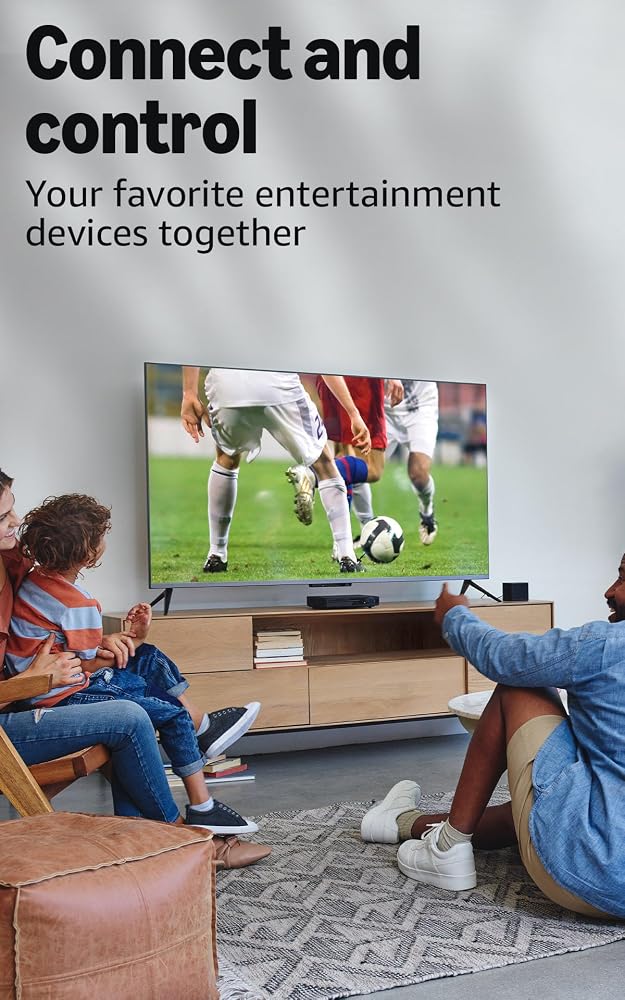
Equipped with an integrated far-field and near-field microphone array alongside a built-in speaker, the device functions as an autonomous voice hub even when the connected television display is powered down. Users can issue voice commands to control IR-enabled consumer electronics, including television volume, soundbar power, and compatible audio/video receivers from across the room. It also communicates seamlessly with auxiliary speaker arrays like an echo premium sound ecosystem.
Because privacy is a critical priority for professionals operating in rented spaces and client offices, the hardware incorporates a physical mute switch. Pressing this button electronically disconnects the microphones, severing the circuit so that the device cannot listen for wake words. This physical isolation mechanism provides visual and mechanical confirmation that audio monitoring is disabled during sensitive client calls, business briefings, or private editing sessions.
Cinematic 4K Output and Multichannel Audio
Visual fidelity is central to the unit’s value, delivering native output resolutions across 2160p, 1080p, and 720p at up to 60 frames per second. The device supports high dynamic range profiles including Dolby Vision and HDR, allowing media specialists to evaluate color grades, dynamic range transitions, and contrast balance on compatible high-end display panels with total clarity.
Audio handling is equally robust, with built-in decoding for Dolby Atmos, 7.1 surround sound, two-channel stereo, and HDMI audio passthrough up to 5.1 channels. Whether you are conducting an impromptu client presentation on a high-fidelity studio monitor or streaming entertainment after a long shoot day, the system passes rich, uncompressed audio channels cleanly to external sound equipment without introducing noticeable sync delays or phase distortion.
Specs
| Processor | Octa-core (4x 2.2GHz, 4x 2.0GHz) |
|---|---|
| GPU | 800MHz |
| Internal Storage | 16 GB |
| Internal Memory | 2 GB |
| Wireless Connectivity | Wi-Fi 6E, Bluetooth 5.0 + LE |
| Physical Ports | HDMI 2.1 Input, HDMI 2.1 Output, USB-A 2.0, Ethernet 10/100Mbps, IR Extender, Power |
| Video Resolution | 2160p, 1080p, 720p up to 60 fps |
| HDR and Picture Standards | Cinematic 4K, Dolby Vision, HDR |
| Audio Support | Dolby Atmos, 7.1 surround sound, 2-channel stereo, HDMI audio pass through up to 5.1 |
| Remote Dimensions and Weight | 38 mm x 158 mm x 17 mm; 51 g (without batteries) |
Full spec sheet from the listing (16 entries)
| 0 | Size, 38 mm x 158 mm x 17 mm |
|---|---|
| 1 | Weight, 51 g (without batteries) |
| 2 | Processor, Octa-core 4x 2.2GHz 4x 2.0GHz |
| 3 | GPU, 800MHz |
| 4 | Storage, 16 GB internal |
| 5 | Memory, 2 GB internal |
| 7 | Bluetooth, Bluetooth 5.0 + LE. Pair with compatible Bluetooth speakers, headphones, video game controllers, and more. |
| 8 | Voice support, Far-field and near-field voice support |
| 9 | Voice control compatibility, Controls a wide range of IR-enabled devices, including TVs, soundbars, cable and satellite boxes, and A/V receivers. |
| 10 | Cloud storage, Free cloud storage for digital content purchased from Amazon. |
| 11 | Ports, HDMI 2.1 Input, HDMI 2.1 Output, IR Extender, Power, USB-A 2.0, Ethernet port 10/100Mbps |
| 12 | Audio support, Dolby Atmos, 7.1 surround sound, 2-channel stereo, and HDMI audio pass through up to 5.1. |
| 15 | Output/Input resolution supported, 2160p, 1080p and 720p up to 60 fps |
| 23 | Batteries, 2 AAA (included) |
| 24 | Technology, Bluetooth 5.0 |
| 25 | Compatibility, Fire TV Cube (3rd Gen), Fire TV 4-Series, Fire TV Omni QLED Series |
Quoted from the product listing, not measured by us.
Amazon Fire TV Cube Pros and Cons
Pros
- Octa-core processor delivers fast performance
- Dedicated Wi-Fi 6E network support
- HDMI 2.1 input for peripheral pass-through
- 16 GB built-in internal storage
- Hardware microphone disconnect button
Cons
- Requires dedicated external wall power
- Ethernet capped at 10/100Mbps speed
- Bulky form factor compared to dongles
Check Amazon Fire TV Cube on Amazon
Best Use Cases
- Traveling video creators who need an octa-core media hub to review high-bitrate 4K content and route secondary video sources on hotel televisions.
- Remote professionals working out of shared creative spaces who require Wi-Fi 6E connectivity to bypass congested local wireless bands.
- Media teams deploying a temporary editing station where an external game console or laptop must share a single television display via HDMI passthrough.
- Privacy-conscious travelers who demand a physical microphone disconnect button alongside hands-free voice navigation for media and smart home feeds.
Before You Buy
Before packing this streaming device into your gear bag, you must account for its power and infrastructure requirements. When analyzing fire tv cube power consumption, remember that this device cannot operate via a standard 5V USB connection from a television display. Unlike featherweight streaming sticks that draw power directly from the display’s integrated service ports, the Cube features a proprietary DC power port and relies on a dedicated AC wall adapter. In hotel setups where desk outlets are sparse or hidden behind heavy furniture, running a fire cube tv setup requires access to an external wall socket and appropriate international power converters if traveling overseas.
It is also vital to note what the manufacturer listing does not specify or include in the standard retail package. While the documentation provides exact dimensions of 38 mm x 158 mm x 17 mm and a weight of 51 g for the included voice remote (along with two AAA batteries), the listing does not specify the precise outer dimensions or weight of the physical cube hub itself. Furthermore, the listing does not specify whether an HDMI cable is included in the box. Traveling creators must ensure they pack their own high-speed HDMI cables to connect both the display output and the auxiliary input port.
How It Compares With Similar Picks
| Product | Best For | Key Difference |
|---|---|---|
| Amazon Fire TV Cube | Multi-device routing and heavy multitasking | Features an octa-core processor, HDMI 2.1 input, Wi-Fi 6E support, and hands-free voice hardware |
| HDR10+ | Streamlined high-end playback | Emphasizes HDR10+, Dolby Vision, Wi-Fi 6, and a Rechargeable Voice Remote Pro with backlit buttons |
Choosing between these two premium media platforms comes down to how you interact with peripheral hardware. The alternative HDR10+ streaming player, known as the Roku Ultra, represents an exceptional choice for media enthusiasts who want dedicated high-dynamic-range support, a rechargeable voice remote with backlit buttons for dark editing suites, and straightforward Wi-Fi 6 networking. However, if your mobile production workflow relies on routing a secondary camera, laptop feed, or gaming platform through a single television display, the Fire TV Cube remains distinct thanks to its hardware HDMI input and octa-core processing architecture.

Bottom Line
Evaluating whether the amazon fire tv cube specs fit a mobile lifestyle requires balancing high-performance hardware against everyday packing logistics. There is no denying that the device outperforms standard streaming sticks across every computing metric. Its octa-core processor eliminates operating system lag, the 16 GB of onboard storage accommodates an expansive suite of production and streaming applications, and the inclusion of Wi-Fi 6E ensures pristine signal acquisition even across crowded travel networks.
So, is fire tv cube worth it for travelers? If you are an editor, creator, or remote professional who spends weeks at a time on location and desires a complete media nerve center that handles HDMI passthrough and client video checks, the performance benefits far outweigh the minor bulk. However, if your travel routine is defined by single-night hotel stays where packing light is paramount, an ultralight USB-powered streaming stick will remain the more practical travel companion.
FAQ
Can the Amazon Fire TV Cube run on TV USB power during travel?
No, the Amazon Fire TV Cube cannot be powered via a standard television USB port. It features a dedicated power port and requires connection to an AC wall outlet via its power adapter, which means you must plan for wall outlet accessibility in temporary work environments.
How does the HDMI 2.1 input benefit a mobile editing setup?
The HDMI 2.1 input allows you to connect an external video source—such as a laptop, gaming console, or field preview feed—directly into the Cube. The unit routes that signal through its primary HDMI output to the television, eliminating the need to reach behind the display to constantly swap cables.
What are the primary differences between the Fire TV Cube and a standard streaming stick?
In a fire tv cube vs streaming stick comparison, the Cube offers an octa-core processor that is twice as powerful as standard sticks, double the internal storage at 16 GB, Wi-Fi 6E network compatibility, a hardware HDMI input, an Ethernet port, and built-in hands-free Alexa microphones with a physical disconnect switch.
Does the Fire TV Cube support Wi-Fi 6E in hotels?
The hardware fully supports Wi-Fi 6E, meaning it can connect to 6GHz wireless networks wherever they are deployed. However, to utilize this standard, the hotel or workspace router must also support and broadcast on the Wi-Fi 6E standard; otherwise, the Cube seamlessly falls back to standard 5GHz or 2.4GHz Wi-Fi.
Is the Fire TV Cube practical as a portable travel setup?
For extended stays, production rentals, or mobile editors establishing a base camp for several days, the fire tv cube portable setup is highly practical due to its speed and input switching. For fast-paced, single-night trips with carry-on luggage only, its dedicated power brick and larger form factor make it less convenient than a pocketable dongle.
How this site works
- 194reviews published
- 2,323products with a buyer rating
- 2,260products with listed features
- 84brands covered
Ratings, prices, stock and specifications are read from the Amazon product listing. We do not run lab tests of our own, so a score here is the average rating left by buyers, not a verdict from a test bench. We track one retailer, so prices here are not a comparison.