Sensor Type in Air Quality Monitors: What It Is and Is It Worth It?
Discover how NDIR sensor type explained improves CO2 accuracy. We compare 6 air quality monitors by published specifications to help you choose the right device for your needs in 2026.
7 min read

Reviewed
Sensor Type in Air Quality Monitors: What It Is and Is It Worth It?
Price today
| Amazon | Not listed | View deal |
|---|
We track one retailer, so this is not a price comparison. Affiliate link; price and stock come from the listing and change without notice.
What you need to know
- The sensor type explained here focuses on NDIR technology. NDIR Sensor Type Explained
- It is the standard for accurate CO2 monitoring. NDIR Sensor Type Options
- This technology measures gas concentrations by detecting infrared light absorption, offering high precision for CO2 levels. Is the NDIR Sensor Worth It
- It provides accurate carbon dioxide readings without frequent recalibration. Air Quality Monitor Glossary
One line lifted from each section below — follow the link to read that section in full.
As Amazon Associates, we earn from qualifying purchases. This means we may receive a small commission at no extra cost to you if you click through and make a purchase.
As an Amazon Associate we earn from qualifying purchases. Links on this page are affiliate links.
NDIR Sensor Type Explained
An air quality monitor uses sensors to detect pollutants in your home. The sensor type explained here focuses on NDIR technology. This stands for Non-Dispersive Infrared. It is a specific method for measuring gas concentrations. You will often see this listed as a key feature on product pages. It helps you understand what the device is actually measuring.
NDIR sensors work by using infrared light. The device emits a beam of infrared radiation through a chamber of air. Pollutants like carbon dioxide absorb specific wavelengths of this light. The sensor measures how much light reaches the other side. Less light means more pollutants are present. This method is highly accurate for detecting CO2 levels. It does not rely on chemical reactions. This makes it stable over time.
You should look for NDIR when checking specifications. Listings may label it as "NDIR," "CO2 Sensor," or "Infrared Gas Sensor." If a product only lists "VOC" or "PM2.5" without mentioning NDIR, it likely lacks this specific capability. VOC sensors detect volatile organic compounds. PM2.5 sensors detect fine particles. NDIR sensors detect carbon dioxide. Each serves a different purpose. A complete system often combines multiple sensors.
Why does this matter to you? High CO2 levels indicate poor ventilation. It signals that stale air is building up. An air purifier with an NDIR sensor can detect this. It may adjust its fan speed automatically. This ensures your air stays fresh. It also helps you know when to open a window. This is practical information for your daily comfort. It goes beyond just removing dust. It monitors the air you breathe. Check the specs to see if your chosen unit includes this technology. It adds value by providing a clearer picture of your indoor environment. You get data that helps you manage your home's air quality effectively.
NDIR Sensor Type Options
NDIR Sensor
NDIR stands for Non-Dispersive Infrared. This technology measures gas concentrations by detecting how much infrared light a gas absorbs. It is the standard for accurate CO2 monitoring. You get consistent readings over time without frequent recalibration. The SAF Aranet4 uses this sensor for precise home monitoring with a four-year battery life. It suits users who value data accuracy over multi-parameter tracking. The main trade-off is that NDIR sensors are typically more expensive than basic electrochemical ones. They also consume more power. However, the long-term reliability often justifies the higher initial cost for serious indoor air quality tracking.
NDIR Sensor
NDIR stands for Non-Dispersive Infrared. This technology measures gas concentrations by detecting how much infrared light a gas absorbs. It is the standard for accurate CO2 monitoring. You get consistent readings over time without frequent recalibration. The BREATHE Airmonitor Plus Gen 2 uses this sensor for comprehensive multi-pollutant tracking. It suits users who need detailed, exportable history of their indoor environment. The main trade-off is that NDIR sensors are typically more expensive than basic electrochemical ones. They also consume more power. However, the long-term reliability often justifies the higher initial cost for serious indoor air quality tracking.
Is the NDIR Sensor Worth It
Who needs it
You should prioritize an NDIR sensor if accurate carbon dioxide monitoring is your primary goal. This technology measures gas concentrations by detecting infrared light absorption, offering high precision for CO2 levels. It is the industry standard for reliable indoor air quality assessment. You benefit from consistent readings that do not require frequent recalibration. If you are concerned about ventilation efficiency or tracking stale air buildup in tight spaces, this spec delivers the data you need. It is ideal for homes with poor airflow or high occupancy. You get peace of mind knowing your monitor provides scientifically valid measurements. This is not just a novelty feature; it is a practical tool for managing your home environment. Choose this if you want to ensure your ventilation system is working correctly and that CO2 levels remain safe and comfortable.
Who can skip it
You can skip the NDIR sensor if you are mainly tracking particulate matter like dust, pollen, or smoke. NDIR technology is designed for gases, specifically carbon dioxide, and does not detect these solid particles. For general allergen monitoring, a laser particle sensor is more appropriate and often more affordable. You might also skip this if you are on a tight budget, as NDIR components can increase the overall cost of the unit. If your main concern is visible dust or pet dander, focus on the CADR rating and filter type instead. NDIR is a specialized tool. It adds value only if you specifically need to monitor air freshness and CO2 levels. For general awareness of air quality without specific gas tracking, other sensors provide sufficient insight without the added complexity or price.
Air Quality Monitor Glossary
NDIR Sensor
Non-Dispersive Infrared technology measures gas concentration by detecting infrared light absorption. It provides accurate carbon dioxide readings without frequent recalibration.
Monitored Parameter
The specific pollutant or metric the device tracks, such as carbon dioxide or particulate matter. This determines what the sensor is designed to detect.
Target Pollutant
The specific airborne contaminant the purifier or monitor aims to remove or measure. Common examples include dust, smoke, or volatile organic compounds.
Room Size
The maximum square footage the air purifier can effectively clean within a set timeframe. Ensure the unit matches your space for proper performance.
Filtration Technology
The method used to capture particles, such as HEPA or activated carbon filters. This defines what types of pollutants the system can remove.
Combo Function
A single device that combines air purification with air quality monitoring. This saves space by handling both cleaning and sensing in one unit.
Form Factor
The physical shape and design of the device, such as tower or box style. This affects where you can place it in your home.
Color
The visual indicator showing current air quality status. Green usually means good, while red signals high pollution levels requiring attention.
| # | Product | Best for | Price |
|---|---|---|---|
| 1 | SAF Aranet4 Wireless CO2 Monitor | precise NDIR CO2 monitoring with long battery life | |
| 2 | BREATHE Airmonitor Plus Gen 2 Wi-Fi Monitor | Detailed multi-pollutant tracking with NDIR accuracy | |
| 3 | YNAK 7-Inch Indoor Air Quality Monitor | Desktop monitoring with NDIR accuracy and history logs | |
| 4 | Gain Express Handheld NDIR CO2 Meter | checking high CO2 levels in large rooms | |
| 5 | TEKCOPLUS Portable CO2 and Humidity Monitor | large rooms needing CO2 alarms | |
| 6 | DANOPLUS Dual-Mode NDIR CO2 Controller | Automated CO2 control with remote sensing |
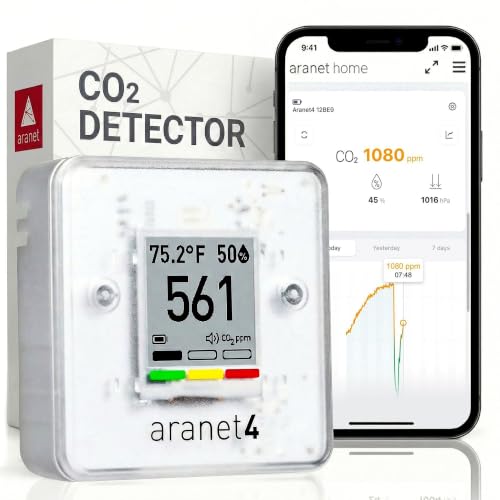
SAF Aranet4 Wireless CO2 Monitor
Best for: precise NDIR CO2 monitoring with long battery life
- Sensor Type
- NDIR Sensor
- Monitored Parameters
- CO2, temperature, humidity, pressure
- Connectivity
- Wireless
- Power Source
- Battery
- Display Type
- E-ink
- Alert Method
- Buzzer, color coding
The SAF Aranet4 is a compact indoor air quality monitor featuring an NDIR sensor for precise CO2 detection. It tracks temperature, humidity, and atmospheric pressure. The device uses an e-ink display and offers a four-year battery life. A smartphone app provides up to 90 days of historical data. This unit suits users who need reliable, wireless monitoring for homes or offices without frequent battery changes.
- NDIR sensor technology for accurate CO2 measurements
- Four-year battery life with e-ink display
- Monitors CO2, temperature, humidity, and pressure
- App provides 90 days of historical data
- Compact size at 2.76 x 2.76 x 0.94 inches
- Smaller 90-day data history compared to competitors offering 15 days or 24-hour history
- Measures only four parameters while other listed models monitor up to 18 parameters
- Heavier at 3.67 ounces compared to typical handheld portable meters
- You want precise NDIR CO2 readings for long-term home monitoring
- You prefer a wireless device with a four-year battery life
- You need to track temperature and humidity alongside CO2 levels
- You require a handheld portable meter for spot checks
- You need to monitor more than four air quality parameters
- You want a device with a 24-hour or longer local history display
Verdict: The SAF Aranet4 NDIR CO2 Monitor delivers precise NDIR measurements and a four-year battery life for users prioritizing long-term home monitoring. It fits buyers who value data accuracy and wireless convenience over multi-parameter tracking or portable use.

BREATHE Airmonitor Plus Gen 2 Wi-Fi Monitor
Best for: Detailed multi-pollutant tracking with NDIR accuracy
- Sensor Type
- NDIR Sensor
- Monitored Parameters
- CO2, PM1, PM2.5, PM10, TVOC, HCHO
- Connectivity
- 2.4 GHz Wi-Fi
- Power Source
- USB-C, battery
- Alert Method
- App alerts
- Data Logging
- 90-day history, CSV export
This device uses an NDIR sensor to measure carbon dioxide levels with high accuracy. It also tracks PM2.5, PM10, TVOC, and formaldehyde using laser and chemical sensors. The unit offers 90 days of history and a 6-hour battery for portable use. It connects to a free app via Wi-Fi for remote monitoring and alerts. This monitor suits you if you need detailed data on indoor air quality parameters beyond just CO2.
- NDIR sensor for precise CO2 measurement
- Tracks PM2.5, PM10, TVOC, and formaldehyde
- 90-day data history with export capability
- 6-hour battery life for portable use
- Real-time alerts via free mobile app
- 6-hour battery limits continuous portable use
- Weighs 4 ounces, adding slight bulk
- Requires 2.4 GHz Wi-Fi for app features
- You want detailed CO2 readings from an NDIR sensor
- You need to track multiple pollutants like VOCs and particles
- You prefer reviewing historical air quality trends over 90 days
- You need all-day battery life without charging
- You only care about CO2 and not other pollutants
- You require 5 GHz Wi-Fi connectivity
Verdict: BREATHE Airmonitor Plus Gen 2 delivers comprehensive air quality data through its NDIR CO2 sensor and multi-pollutant tracking. It fits users who need detailed, exportable history of their indoor environment rather than simple real-time readings.

YNAK 7-Inch Indoor Air Quality Monitor
Best for: Desktop monitoring with NDIR accuracy and history logs
- Sensor Type
- NDIR Sensor
- Monitored Parameters
- CO2, PM1.0, PM2.5, PM10, HCHO, TVOC
- Power Source
- Built-in battery
- Display Type
- 7-inch TFT
- Data Logging
- 24-hour and 15-day history
- Features
- Air Quality Monitor
This YNAK monitor tracks CO2 with a True NDIR sensor, which offers higher accuracy than semiconductor types. It also measures PM1.0, PM2.5, PM10, HCHO, TVOC, temperature, and humidity. The 7-inch TFT display shows real-time data and color-coded alerts. You get 24-hour and 15-day history logs to spot trends. It runs on a 5000mAh battery for up to 8 hours of portable use.
- True NDIR CO2 sensor for reliable readings
- 7-inch TFT display with automatic day/night themes
- 24-hour and 15-day trend history logging
- 5000mAh battery supports up to 8 hours of operation
- Monitors nine parameters including PM2.5 and formaldehyde
- Battery lasts only 8 hours on a full charge
- 7-inch display requires more counter space than handheld units
- Portable use is limited to 8 hours without recharging
- You want True NDIR CO2 accuracy in a single device
- You need to track air quality trends over 15 days
- You prefer a large 7-inch display for easy reading
- You need a handheld unit that fits in your pocket
- You require continuous operation without frequent recharging
- You only need to monitor CO2 levels
Verdict: YNAK 18-in-1 NDIR Air Quality Monitor fits users who need a comprehensive desktop monitor with a large screen and long-term history tracking. It suits those who prioritize NDIR sensor accuracy and visual clarity over portability.

Gain Express Handheld NDIR CO2 Meter
Best for: checking high CO2 levels in large rooms
- Sensor Type
- NDIR Sensor
- Monitored Parameters
- CO2, temperature, humidity, dew point
- Power Source
- Battery or 9V adaptor
- Alert Method
- Alarm function
- Features
- Air Quality Monitor
- Form Factor
- Portable
This handheld monitor uses an NDIR sensor to measure carbon dioxide from 0 to 9999 ppm. It also tracks temperature and humidity in a single unit. The device offers manual calibration for CO2 and humidity. You get a large display range suitable for offices and classrooms. The yellow casing is compact and fits in one hand.
- NDIR sensor ensures stable CO2 readings
- Measures up to 9999 ppm CO2
- Monitors temperature and humidity simultaneously
- Allows manual calibration for accuracy
- Accuracy drops to ±10% above 2000 ppm
- 9V adapter is not included in the package
- You need to check high CO2 levels in crowded rooms
- You want a portable device for office surveys
- You require manual calibration for your measurements
- You need automatic calibration features
- You want to track PM2.5 particles
- You prefer a device with a built-in power adapter
Verdict: Gain Express Portable CO2 Meter is a focused tool for checking air quality in large spaces. It fits users who need high-range detection and manual control over calibration settings.

TEKCOPLUS Portable CO2 and Humidity Monitor
Best for: large rooms needing CO2 alarms
- Sensor Type
- NDIR Sensor
- Monitored Parameters
- CO2, temperature, humidity, dew point
- Display Type
- LCD with backlight
- Alert Method
- Audible and visual alarms
- Features
- Air Quality Monitor
- Form Factor
- Portable
The TEKCOPLUS COTK-57 uses an NDIR sensor to measure carbon dioxide levels up to 9999 ppm. It also tracks temperature and relative humidity on a large LCD screen with backlighting. The device triggers audible and visual alarms when CO2 exceeds your set threshold. This portable unit is designed for monitoring air quality in homes, offices, classrooms, and factories. You get real-time data to help manage ventilation needs.
- NDIR sensor for accurate CO2 detection up to 9999 ppm
- Large LCD screen with backlight for clear readings
- Audible and visual alarms when CO2 exceeds threshold
- Measures temperature, humidity, dew point, and wet bulb
- Portable form factor for easy transport
- Accuracy drops to ±10% for readings above 2000 ppm
- Bulky dimensions of 13.8 x 2.76 x 8.66 inches
- Single yellow color option only
- You need to monitor CO2 levels in larger spaces like offices or classrooms
- You want audible and visual alerts when air quality drops
- You require simultaneous tracking of temperature and humidity
- You need high precision below 2000 ppm where other monitors offer ±5%
- You prefer a compact handheld device under 5 inches in length
- You want a monitor with a digital display color other than yellow
Verdict: The TEKCOPLUS Portable CO2 Monitor fits users who need broad-range CO2 detection with immediate alarms in commercial or large residential settings. It suits those who prioritize visible alerts and multi-parameter tracking over compact size or high precision in lower CO2 ranges.

DANOPLUS Dual-Mode NDIR CO2 Controller
Best for: Automated CO2 control with remote sensing
- Sensor Type
- NDIR Sensor
- Monitored Parameters
- CO2
- Display Type
- LCD
- Alert Method
- Audible buzzer alarm
- Dimensions
- 6.1 × 4.1 × 1.96 inches
- Weight
- 12.8 ounces
This DANOPLUS unit is a CO2 controller designed for automated environmental management. It features a high-precision NDIR sensor accurate to ±50 ppm or ±5%. The device includes a 15-foot external probe and a built-in photo-cell that pauses operation at night. It offers dual modes for human or plant care and displays CO2 trends on an LCD screen. It suits users who need precise, automated control over carbon dioxide levels in specific zones.
- High-precision NDIR sensor with ±50 ppm accuracy
- 15-foot external probe for remote monitoring
- Built-in photo-cell pauses generator at night
- LCD displays CO2 trends and max/min records
- 15-foot probe limits placement flexibility compared to wireless models
- 12.8-ounce weight makes it less portable than handheld detectors
- Requires piggyback socket connection rather than direct device integration
- You need automated CO2 control for plant growth cycles
- You want to monitor CO2 levels from a distance
- You prefer manual threshold alarms over app notifications
- You require a portable, handheld device for quick checks
- You need wireless connectivity for remote monitoring
- You are monitoring general indoor air quality rather than specific CO2 targets
Verdict: DANOPLUS CO2 Controller with 15ft Probe fits growers who need precise, automated CO2 management with remote sensing capabilities. It is ideal for users who prioritize sensor accuracy and automated night-time pausing over portability.
Specifications side by side
| Spec | SAF Aranet4 Wireless CO2 Monitor | BREATHE Airmonitor Plus Gen 2 Wi-Fi Monitor | YNAK 7-Inch Indoor Air Quality Monitor | Gain Express Handheld NDIR CO2 Meter | TEKCOPLUS Portable CO2 and Humidity Monitor | DANOPLUS Dual-Mode NDIR CO2 Controller |
|---|---|---|---|---|---|---|
| Monitored Parameters | CO2, temperature, humidity, pressure | CO2, PM1, PM2.5, PM10, TVOC, HCHO | CO2, PM1.0, PM2.5, PM10, HCHO, TVOC | CO2, temperature, humidity, dew point | CO2, temperature, humidity, dew point | CO2 |
| Sensor Type | NDIR | NDIR, laser particle | True NDIR | NDIR | NDIR | 2-channel NDIR |
| Connectivity | Wireless | 2.4 GHz Wi-Fi | – | – | – | – |
| Power Source | Battery | USB-C, battery | Built-in battery | Battery or 9V adaptor | – | – |
| Display Type | E-ink | – | 7-inch TFT | – | LCD with backlight | LCD |
| Alert Method | Buzzer, color coding | App alerts | – | Alarm function | Audible and visual alarms | Audible buzzer alarm |
| Data Logging | App (up to 90 days) | 90-day history, CSV export | 24-hour and 15-day history | – | – | – |
| Features | Air Quality Monitor | Air Quality Monitor | Air Quality Monitor | Air Quality Monitor | Air Quality Monitor | – |
| Form Factor | – | – | – | Portable | Portable | – |
| Monitored Parameter | Humidity, Temperature, CO2 | PM2.5, CO2, VOC, Formaldehyde | PM2.5, Humidity, Temperature, CO2, VOC, PM10, Formaldehyde | Humidity, Temperature, CO2 | Humidity, Temperature, CO2 | CO2 |
| Color | White | White | History Tracking & White | Yellow | Yellow | CO2 Controller |
| Placement | Home, Office | Home | – | Home, Office | Home, Office | – |
| Dimensions | 2.76 × 2.76 × 0.94 inches | 1.4 × 2.8 × 3.3 inches | – | 2.76 × 2.17 × 8.27 inches | 13.8 × 2.76 × 8.66 inches | 6.1 × 4.1 × 1.96 inches |
| Weight | 3.67 ounces | 4 ounces | – | 7.05 ounces | 4.64 ounces | 12.8 ounces |
| Size | 70x70x24 mm / 2.76×2.76×0.94 inches | – | Standard | – | 35.5×22.4×7.3cm | – |
| Model | TDSPC003.001 | BTL40001 | WBA02 | A017755 | COTK-57 | KB0297 |
Frequently asked questions
What does NDIR mean for air quality monitors?
NDIR stands for Non-Dispersive Infrared. This technology measures gas concentrations by detecting how much infrared light a specific gas absorbs. It is the standard for accurate carbon dioxide monitoring. You get consistent readings over time without frequent recalibration. This makes it reliable for long-term home or office use.
Which monitors use NDIR sensors for CO2?
Several models on this list use NDIR sensors for precise CO2 tracking. The SAF Aranet4 offers wireless monitoring with a four-year battery life. The BREATHE Airmonitor Plus Gen 2 adds multi-pollutant tracking. The YNAK 7-Inch unit provides desktop history logs. The Gain Express and TEKCOPLUS meters are portable options for large spaces.
Are NDIR sensors better than electrochemical ones?
For carbon dioxide specifically, NDIR is generally superior. Electrochemical sensors are better for gases like carbon monoxide. NDIR sensors do not consume the target gas during measurement. This allows for stable, long-term accuracy without the drift often seen in electrochemical devices. They are the preferred choice for indoor CO2 monitoring.
Do I need an NDIR sensor for general air quality?
You need an NDIR sensor if accurate CO2 tracking is your priority. Many monitors combine NDIR for CO2 with other sensors for PM2.5 or VOCs. The BREATHE Airmonitor Plus Gen 2 tracks five parameters including formaldehyde. The YNAK unit also monitors humidity and temperature alongside CO2 using NDIR technology.
How accurate are NDIR air quality monitors?
NDIR sensors are known for high precision in CO2 detection. They provide reliable data without frequent recalibration. The SAF Aranet4 is noted for precise measurements and long battery life. The DANOPLUS controller uses a remote probe for automated management, ensuring accurate readings in specific environments like grow rooms.
What is the difference between portable and fixed NDIR monitors?
Portable units like the Gain Express and TEKCOPLUS meters are handheld for spot checks. They are ideal for large rooms or commercial spaces. Fixed or desktop units like the SAF Aranet4 and YNAK stay in one place. They offer continuous monitoring and history logs for long-term data analysis in your home or office.
Can NDIR sensors detect other pollutants besides CO2?
The NDIR sensor itself specifically targets carbon dioxide. However, many devices combine it with other sensors. The BREATHE Airmonitor Plus Gen 2 adds PM2.5, VOC, and formaldehyde detection. The YNAK 7-Inch monitor includes humidity and temperature sensors alongside its NDIR CO2 capability. This provides a comprehensive view of your indoor air quality.
See also
How this site works
- 1,806reviews published
- 2,323products with a score
- 2,260products with listed features
- 84brands covered
Prices, stock and specifications are read from the Amazon product listing. We do not run lab tests of our own; scores are out of 10, based on listed specifications and buyer feedback, not a verdict from a test bench. We track one retailer, so prices here are not a comparison.


